
A Worthy Successor?
Reviewing 'Prehistoric Planet: Ice Age'

The first two seasons of Apple TV’s Prehistoric Planet (released in 2022 and 2023, respectively) are widely considered to be some of the best television documentaries on prehistoric life. Set during the Maastrichtian age of the Late Cretaceous, a hair’s breadth away from the apocalyptic asteroid strike, the show explored a variety of fascinating ecosystems and animals. These ranged from icons like Tyrannosaurus and Mosasaurus to lesser-known taxa like Qianzhousaurus and Kaikaifilu. The first two seasons were narrated by the inimitable David Attenborough, whose gravitas elevated the material even further.
On November 26th, 2025, a very different third instalment of Prehistoric Planet was released; Prehistoric Planet: Ice Age. This season is narrated by Tom Hiddleston, and tells a roughly chronological story of the Pleistocene epoch. According to executive producer Mike Gunton, Attenborough was never planned to narrate this season. In an interview with Jasmine Valentine for Techradar, he said:
“We just thought it would be an interesting idea, to take a different direction. Tom, of course, is quite a well known wildlife narrator on Apple so it seemed like a good opportunity.”
The full interview can be found here.
To state the obvious, Tom Hiddleston is not David Attenborough. The positive takeaway here is that he’s not trying to be. His style of voiceover is distinct, and it never feels like he’s trying to imitate or outdo Attenborough. Whether or not you like his cadence is subjective, but his theatre training shines through in his clear enunciation and well-paced delivery. I enjoyed him quite a bit.
Quick disclaimer: I won’t be discussing the ‘beneath the ice’ segments that close out each episode in this article. While they are worth watching, I prefer to focus on the more narrative-driven parts of the show, which I believe should be able to stand on their own without the input of scientific advisors. Like I said, they’re worthwhile viewing, and treat the audience to some entertaining imagery, such as Smilodon prowling through a skatepark, Arctotherium scratching his back on a phone booth, and Elasmotherium munching on some flowers outside a florists’.
The Big Freeze + General Critiques
As Hiddleston will remind you in the prologue of every episode, this season takes place during the Ice Ages. Episode one is titled The Big Freeze, and opens with a nail-bitingly tense scene of a woolly mammoth being forced to give birth amidst a ferocious blizzard. In my opinion, this is a strong opening, as it establishes the setting and stakes quickly and effectively. Needless to say, the visual effects are stunning, on par with if not better than those featured in the first two seasons. In addition to CGI and digital effects, the production team utilised practical effects such as puppets. Unlike prior seasons, the animals are brought to life by Framestore, the same studio that worked on the ground-breaking Walking with… franchise. It almost goes without saying that they’ve done an incredible job. If you ask me, Megaloceros (which appears in the season finale, The Big Melt) is their crowning achievement, but all of the models look absolutely phenomenal.
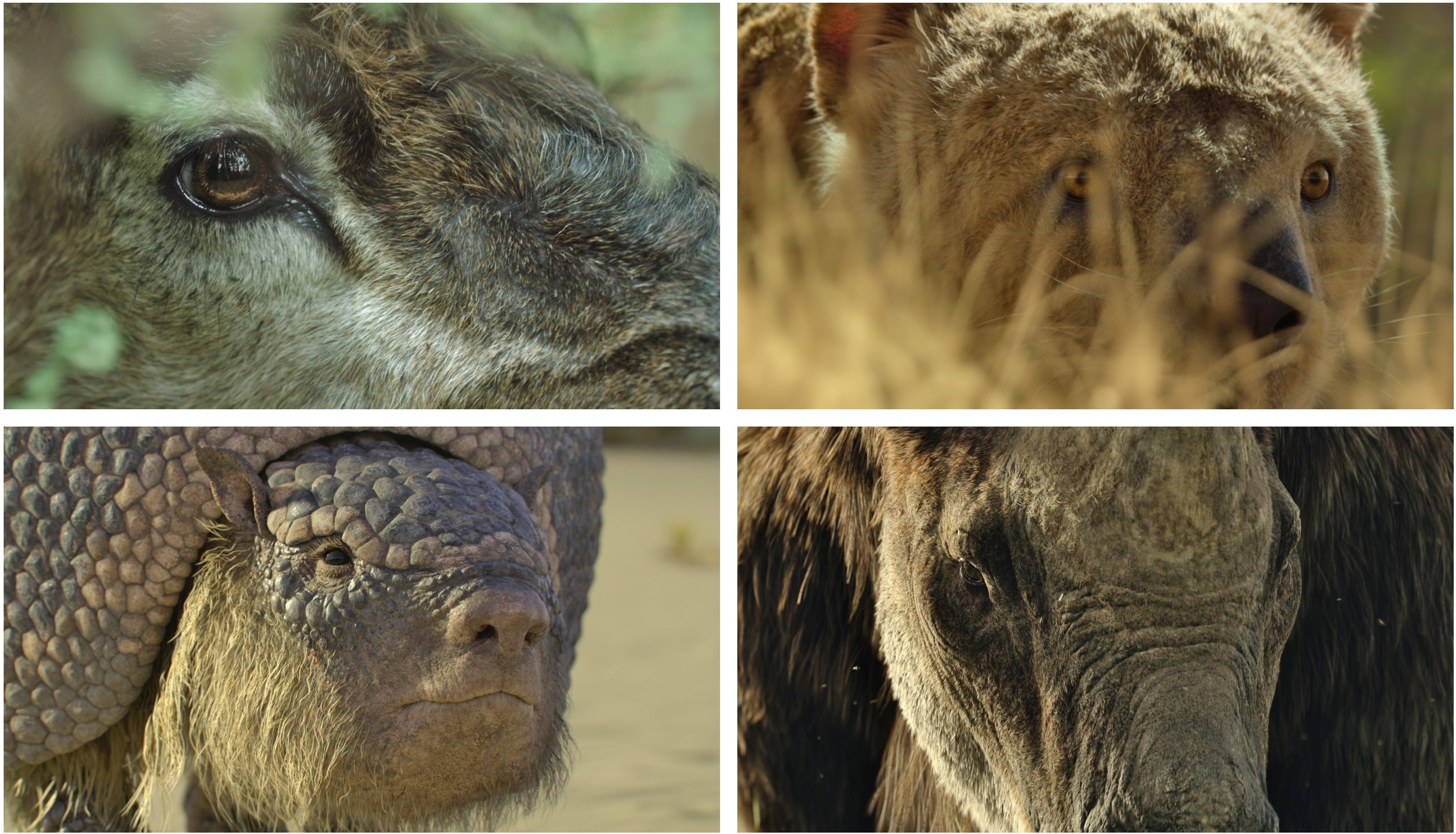
Before we go any further, it’s probably best to address some overarching criticisms I have of this season. It’s a lot simpler than pointing them out whenever they come up. First of all, the script tends to be vague with where we are in any particular scene. To give some examples, The Big Freeze mentions the nebulous ‘far north’ on multiple occasions, which results in the confusing implication that Megalonyx coexisted with Coelodonta and Homotherium latidens, despite them living on different continents. In New Lands, we are not told that we are on the island of Sumba, Indonesia, home to Stegodon and the giant death storks (actual storks, not azhdarchids this time); in fact, we’re not even told that we’re in Asia. In Desert Lands, we shift focus from Thylacoleo and Procoptodon in Australia to the giant moa in New Zealand, with no indication in the script that we’ve actually gone anywhere. This is not an exhaustive list, and it’s honestly a baffling problem to have. Let’s say that Hiddleston couldn’t come back to record some extra lines about the geography for whatever reason; why not add location info on-screen in post-production? I struggle to understand how this becomes an issue for such a high-budget production.
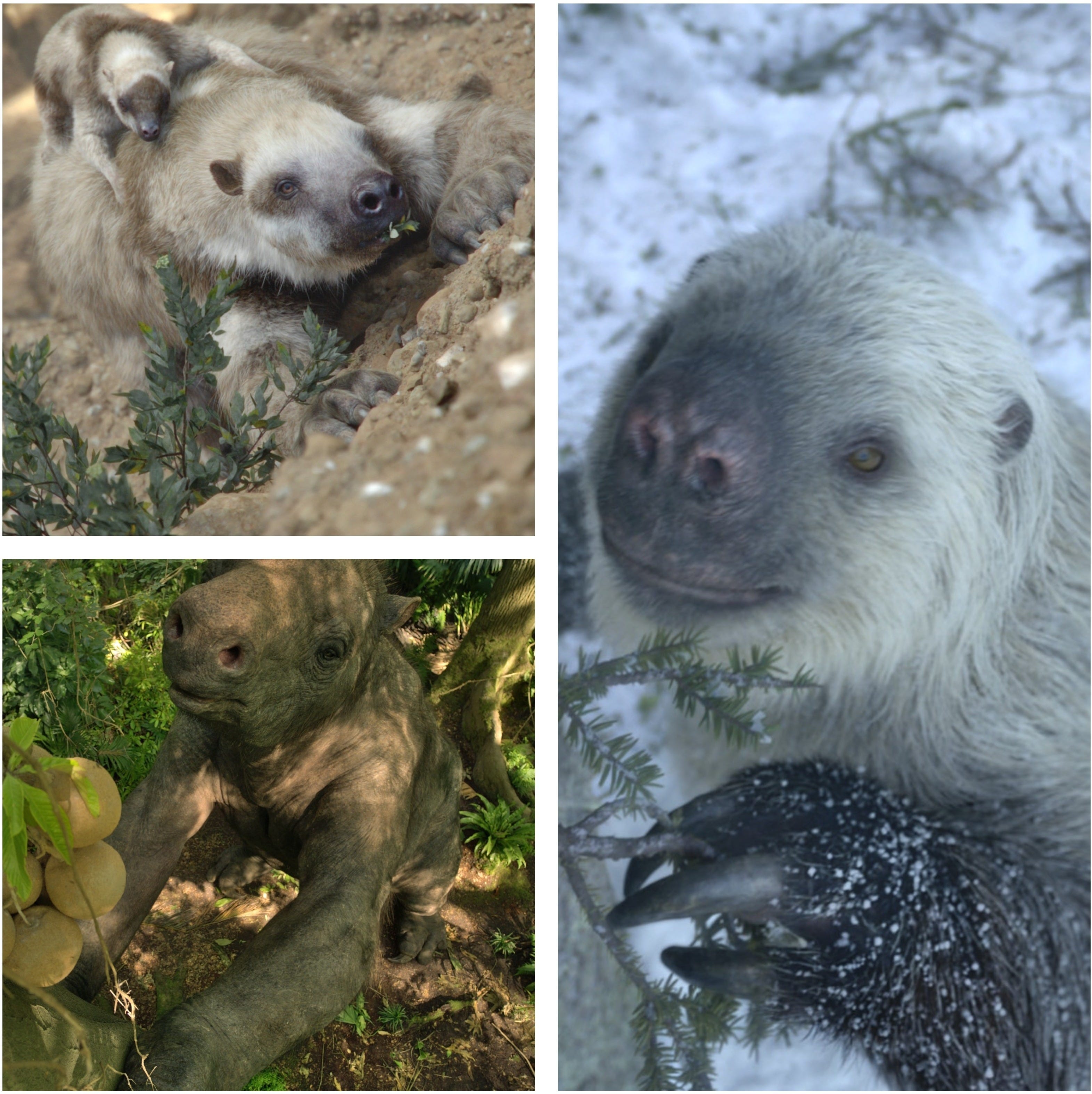
Another issue I have is the script’s reluctance to refer to animals by their scientific names. While some animals, such as Coelodonta the woolly rhinoceros, are better-known by their colloquial names, this becomes an issue with lesser-known taxa. Three ground sloths appear throughout the season; Megalonyx in The Big Freeze, Eremotherium in New Lands, and Diabolotherium in Desert Lands. None of them are named. What makes this frustrating is that, during Diabolotherium’s segment, we are told that ‘there are more than twenty species of Ice Age sloth’… while the script refuses to name any of them, including the ones we are looking at. It’s obvious from their designs that the three sloths we see are not intended to represent the same species, but it’s not clear at all what species they are meant to represent. The only way I was able to confirm Diabolotherium’s identity was by scouring advisor Darren Naish’s social media feed. (Thank you, Darren, genuinely.) This vagueness in the script would pose a considerable challenge for any viewer who might be inclined to do some further reading on the animals depicted.
Again, while I won’t give an exhaustive list, this problem is present throughout the season. Enhydriodon in Grass Lands is simply ‘an enormous otter’, Arctodus in The Big Melt is just ‘a short-faced bear’, and Glyptotherium in New Lands is nothing more than ‘an Ice Age armadillo’. Throughout the season, we see three species of Homotherium, those being H. latidens in The Big Freeze, H. ethiopicum (probably) in Grass Lands (put a pin in that, we’ll get back to it later), and H. serum in The Big Melt. Despite being a relatively well-known animal, at no point is Homotherium referred by its generic name, only as a ‘scimitar-toothed cat’. As a palaeontology nerd, I know that sabre-toothed cats and scimitar-toothed cats refer to machairodontines in the clades smilodontini and homotherini, respectively. For a viewer less nerdy than me, the distinction is not clear. They look different, as Smilodon is depicted with exposed sabre-teeth whereas Homotherium is not, but I’m not convinced that’s enough. This show is meant to be educational; shying away from scientific terminology does little to educate, and at worst, condescends to the audience.
The majority of the problems I have with Prehistoric Planet: Ice Age are rooted in the script. We see carnivores doing precious little but hunting and feeding, barring a few exceptions, such as the young female Smilodon scent-marking new territory in The Big Freeze. Herbivores, by contrast, are shown engaging in a more diverse and complex range of behaviours. (Aside from Macrauchenia, who exist to be horribly killed in three out of the four scenes they feature in.) Attempting to structure the season chronologically also causes some inconsistences; animals such as Gigantopithecus and Enhydriodon appear in the penultimate episode, despite having gone extinct much earlier in the Pleistocene than the show suggests. There are a number of sequences where the season’s central theme of extinction feels like an afterthought, almost shoehorned in when it has little relevance to what we’re seeing on-screen. Furthermore, there are a number of scenes where the theme would be relevant - such as the sequence featuring Steller’s sea cow, hunted to extinction by humans in the 18th century - yet it goes unmentioned. The result is a season that feels less cohesive than its predecessors, and I think this is because the show tries to do too much at once. On one hand, it wants to a Planet Earth-style docuseries showcasing animals across various biomes just living their lives. On the other hand, it wants to be a cautionary tale about climate change and anthropogenic extinctions, despite humans only appearing briefly at the very end of the finale. On a third hand (I guess), it wants to be family-friendly edutainment, which means that the tone has to be lighter and more comedic for younger viewers. In isolation, none of these ideas are bad, but they don’t blend together well.
A more complicated criticism I have is to do with the cast of animals depicted in the show. This carries over from prior seasons to an extent, as reviewers sometimes took issue with the low number of mammals, birds (including enantiornitheans), and crocodylomorphs featured across the Maastrichtian settings. Here, we see an overwhelming focus not only on terrestrial taxa, but on mammals and birds above anything else. The only marine animal we meet is Steller’s sea cow, and even then, it spends most of its screentime stranded on a beach. The first two seasons did not have this problem, as the episodes Coasts and especially Oceans provided insight into various marine ecosystems throughout the Maastrichtian. I won’t speculate on why the marine fauna is so lacking this season, but there’s certainly room for improvement. For example, glacial periods are known to have impacted cetacean migration patterns1, which presents an opportunity to showcase some Pleistocene cetaceans, such as the ugly-cute blunt-snouted dolphin2. Should a cetacean-focused sequence require an antagonist, the imposing shark Cosmopolitodus hastalis would suit the role well3; although primarily known from Miocene deposits, a 2017 paper by Ebersole, Ebersole, and Cicimurri referred material to the taxon from an early Pleistocene fossil locality in the Gulf of Mexico4. Another marine animal that could’ve been worthwhile to feature is the great auk, a flightless relative of puffins that went extinct in the 19th century. While they are fascinating birds on their own merits, a sequence focused on them also would have served as an enjoyable call-back to the appearance of Hesperornis in season two. Unfortunately, marine fauna isn’t all that the show is lacking…
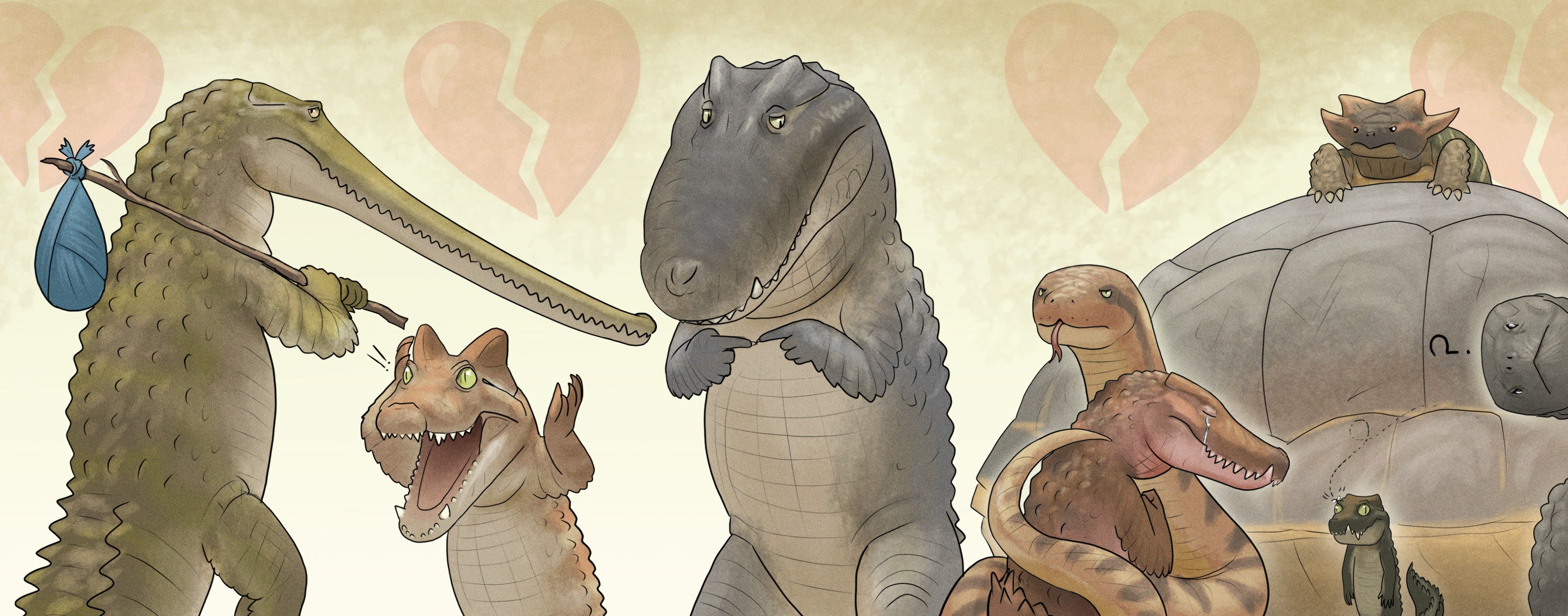
I’ll admit, the lack of non-avian reptiles in Prehistoric Planet: Ice Age is a bit of a sore spot for me. We spend time with no more than two of them in this season, those being the extant thorny devil and the extinct Varanus priscus, also known as megalania. Both of their appearances are rather brief. As my fellow crocodilian enthusiast Armin Reindl details in this thread on Bluesky, the Pleistocene offers ample opportunities for crocodilian representation, ranging from the mekosuchines of Australia to the slender-snouted Euthecodon of Africa. This becomes especially frustrating when New Lands features what I can only describe as a crocodile fake-out, but we’ll get back to that scene when it’s relevant. There are also no testudines present, despite the Pleistocene having a record of the largest tortoise to ever live, Megalochelys atlas, in addition to the meiolaniids Ninjemys and Meiolania in Australasia. Some viewers may have been hoping to glimpse Wonambi, last of the madtsoiid snakes and a native of Australia that went extinct under 50,000 years ago. One could argue that, given the season’s setting, a focus on mammals and birds is to be expected. That’s probably fair, but glossing over non-avian reptiles to this degree, in my opinion, undersells the true biodiversity of the Pleistocene.
Anyway, back to the mammoths.
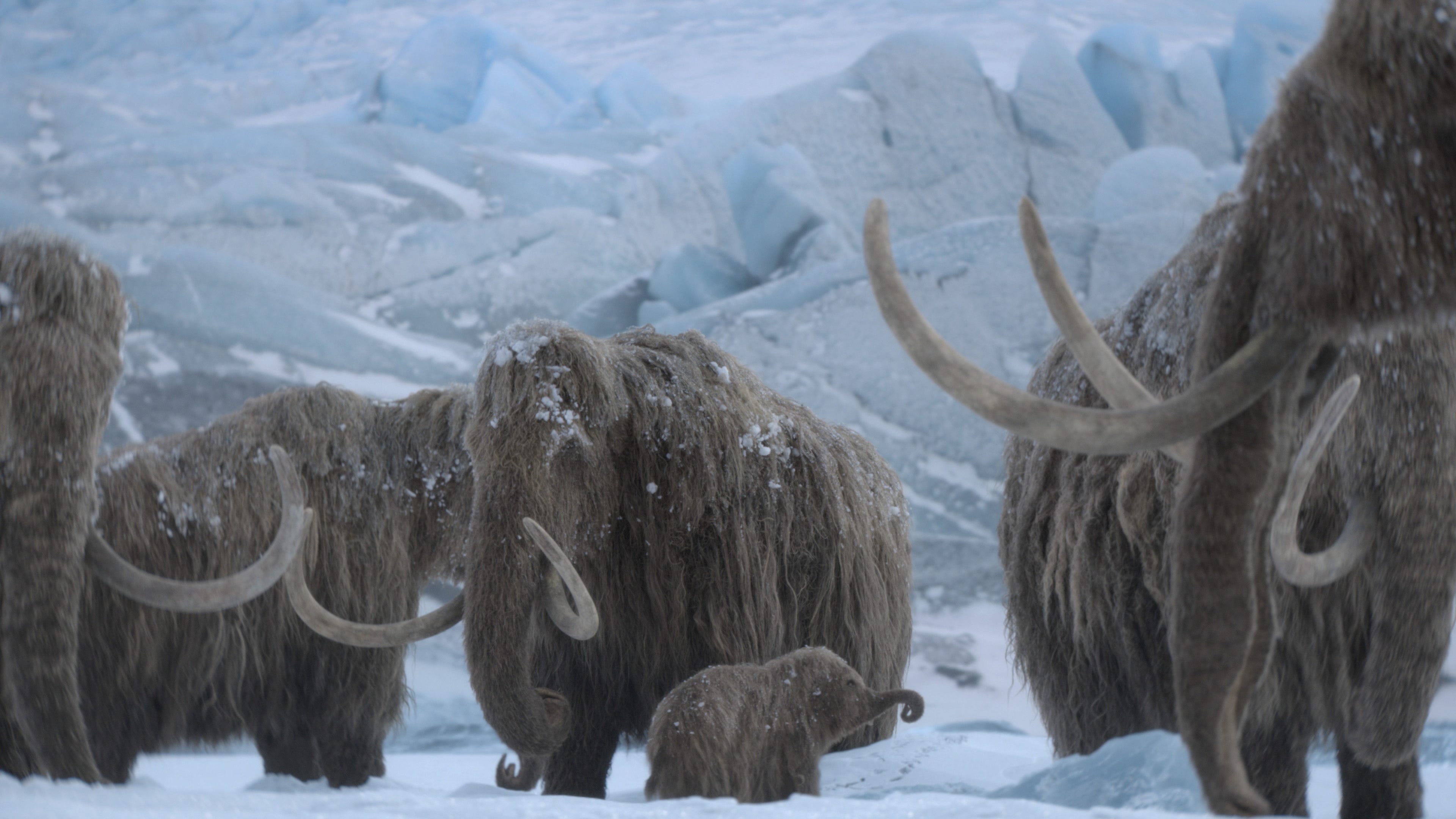
Miraculously, the new-born calf survives the blizzard. This season’s infant mortality is surprisingly low, a significant departure from prior seasons. Bloodthirsty viewers (you know who you are) may be disappointed by this, but I don’t mind. Does anyone really want to see a neonatal mammoth freeze to death? As mentioned above, Prehistoric Planet: Ice Age is quite clearly aimed towards a younger audience than its predecessors. There are fewer gruesome baby deaths, and a lot more comedic scenes (some work, and some fall a bit flat). This tone is even reflected in the soundtrack at points, with scenes such as the Megalonyx family rolling in the snow being accompanied by a jaunty jingle. Perhaps this is due to the popularity of the animated Ice Age movies, but we can only speculate.
For me, the highlight of The Big Freeze takes place as we witness a pair of cave lions attempting to prey on cave bear cubs. While big cats hunting bears may be difficult to believe, there is evidence for this type of interaction between these two species, detailed in a 2011 study by Diedrich5. This is the first of many segments to feature extant fauna; an Arctic fox leads us into the cave, as Hiddleston explains that the plummeting temperatures and harsh weather conditions have led a number of animals to take up residence within. We also briefly glimpse Megaloceros and a dire wolf at this point; rather odd in the latter’s case, as they did not inhabit Eurasia, but excusable for a blink-and-you’ll-miss it appearance. The cinematography and shot composition throughout this sequence - which is split into two parts - is beautiful to look at, and the scenes shot with a night-vision camera are especially impressive. The cave setting gives the sequence an uncomfortably claustrophobic atmosphere, which is amplified by the frequent use of close-up shots all throughout, adding to the tension. We are also introduced to cave hyenas, which are rarely featured in palaeo-media. Hiddleston refers to them as ‘the gatekeepers of this underworld’, an unexpected but evocative allusion to the three-headed hound Cerberus of Greek mythology. We’ll see them again in the finale. While we don’t get the best idea of the animals’ colouration due to the sequence mostly being shot using night-vision, we can see that the cave hyenas have spotted coats and small ears, which seems to be directly inspired by how they are depicted in cave art from France6. The bear cubs survive the lions’ predation attempt, but not thanks to their mother. Another cave bear materialises seemingly out of nowhere and kills one of the cave lions, leaving the hyenas to scavenge its remains. This heroic bear is there one moment, then gone the next. It’s a rather perplexing conclusion to what is otherwise a great segment, but it’s visually stunning enough that I’m willing to overlook the minor flaws.
A family of Megalonyx feature prominently in The Big Freeze. While not stated in the script, the species M. jeffersonii very much meets the criteria of ‘giant’ ground sloth, weighing over a tonne. We meet a mother, her three-year-old son, and his younger sister, who is only a few months old. The variation seen in the episode may be based on a 2022 paper by Semken Jr. et al., which describes the remains of three individuals in the same age range from Southwestern Iowa, U.S.A., hypothesised to represent a family unit that died together7. Both visually and behaviourally, I think these are the most endearing ground sloths to appear in the show. Our first encounter with the family really plays up how cute they are, as we see them rolling around in the snow in order to clean their thick, shaggy fur. My first impression was that this behaviour was too adorable to be realistic, but I was wrong. It turns out that polar bears clean themselves in a similar way, and it’s almost as cute when they do it. The three of them then venture out to feed, and we see the very young female climbing up a tree in order to access the vegetation. The narration mentions that only young ground sloths are capable of climbing, consistent with a 2019 paper by Andy D. Grass8. Unfortunately for the little lady, she soon finds out that just because she can climb, doesn’t mean she should. She falls flat on her face, but eventually manages to feed by climbing on her older brother’s back to chomp on some pine needles. I’d say these scenes are a good introduction to ground sloths as a whole, but they’re not the most memorable part of the episode.
The first machairodontine that appears in Prehistoric Planet: Ice Age is Homotherium latidens, which inhabited Eurasia. Late in 2024, a remarkably well-preserved cub of H. latidens was described from Siberian permafrost9, revealing what these cats looked like early in life. Unfortunately, this discovery was made too far into the production schedule for it to be incorporated into Prehistoric Planet: Ice Age, but the H. latidens model is impressive nonetheless. Its sabre-teeth are concealed when its mouth is closed, courtesy of advisor Mauricio Antón’s work10. This trait is consistent across the three species of Homotherium seen in the season, helping to visually distinguish them from the two Smilodon species that are featured. In The Big Freeze, a group of H. latidens launch an ambush against a herd of Coelodonta, one that feels reminiscent of a confrontation between Nanuqsaurus and Pachyrhinosaurus in the show’s first season. Before the attack, the narration mentions that Coelodonta have a hump on their back that acts as a fat reserve, reflective of a study by Boeskorov et al., published in 202411. Their use of their horns to push aside snow so that they can graze was suggested by a 2012 study by Stuart and Lister12. While there exists no direct evidence of social hunting in Homotherium’s fossil record, such as bone-beds, some of their genomic features suggest that it is a possibility13. Although they zero in on an elderly female with poor vision, their hunt is unsuccessful, as the rest of the herd return to fend them off. At the end of the sequence, we see the elderly female - dubbed ‘grandma’ by Hiddleston - reunite with the herd’s youngest member, an adorable calf. A bit saccharine, granted, but not insultingly so.
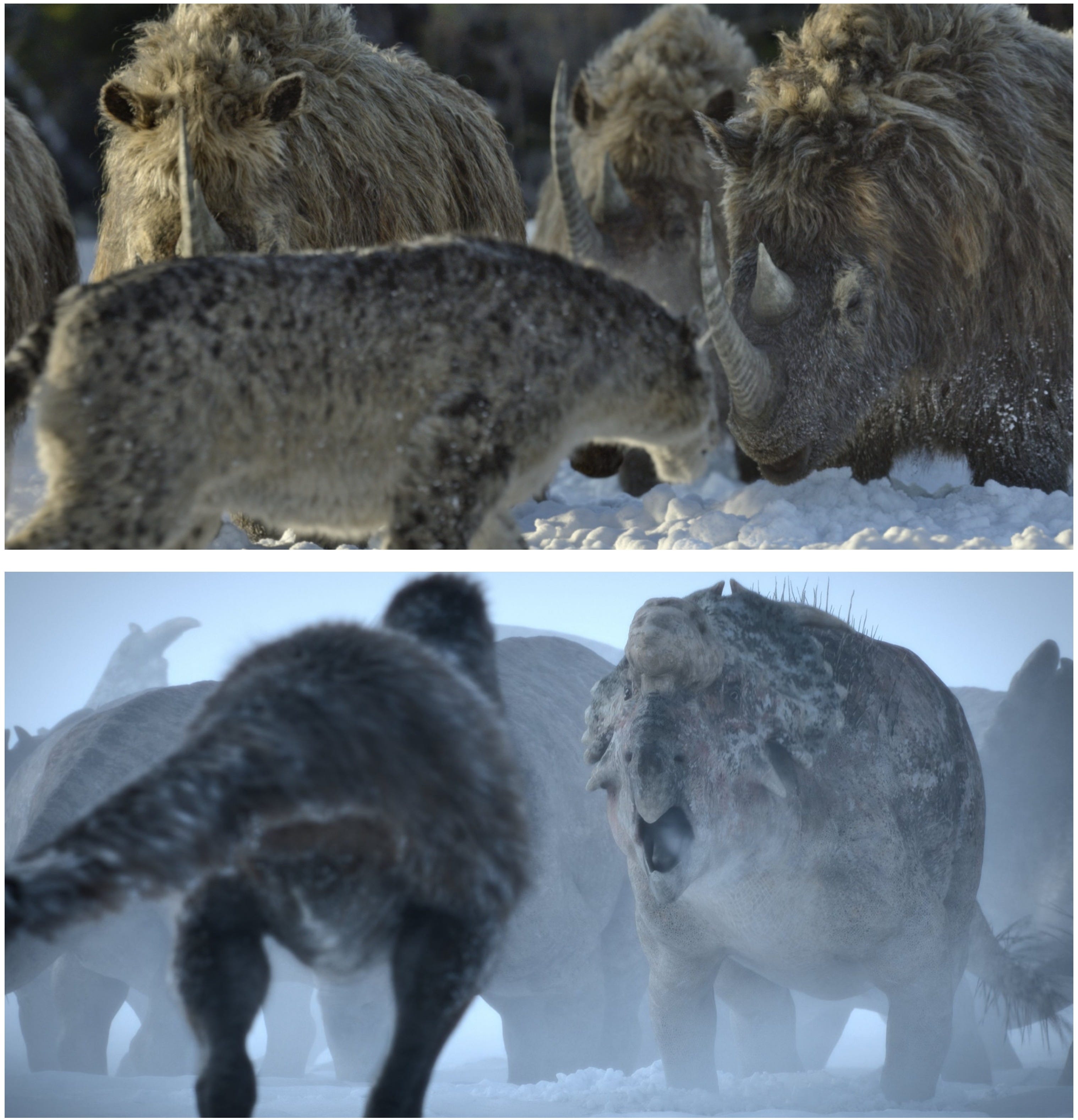
Also in this episode, we meet the famous Smilodon populator. A young female has recently left her family, and is dealing with a peculiar problem; she has double sabre-teeth14. While one could argue that Smilodon is over-represented in media about the Pleistocene, this sequence showcases a recent discovery about them very well, and feels less played-out than it could be. In contrast to Homotherium, Smilodon are portrayed with exposed sabres, which was likely based on another paper by Anton15, about its close relative Megantereon. The sexual dimorphism portrayed here is interesting, possibly based on the findings of Christiansen and Harris from 2012, albeit that paper was about S. fatalis16. We see her scent-marking as she enters unfamiliar territory for the first time; typical cat behaviour, but not one we often see portrayed with Smilodon. Although this sequence is primarily focused on hunting behaviours, it at least feels justified. As the narration states, the female’s double sabres inhibit her from effectively taking down large prey, which puts her at risk of starvation. We see this as she fails to overpower a Macrauchenia on her own, though a larger male soon arrives to remedy this. Whether or not Smilodon were gregarious remains a contentious topic; recent studies have suggested that their social habits may have been regionally variable17, but I don’t think it’s unreasonable for the show to portray them as solitary. This the first Macrauchenia to be killed this season; it will not be the last. The only critique I have is that her ‘flirting’ with the male may imply a little too much foresight on her part to be fully believable. Then again, I’ve seen my cats do stranger things. It’s also nice to see some courtship behaviour on display here, as it is a rare sight this season.
All in all, The Big Freeze serves as an effective introduction to the season. Introducing famous animals like Smilodon and woolly mammoths early on is likely to help a layperson engage with the material, while still including somewhat more obscure taxa such as Megalonyx and cave hyenas. This episode also showcases the commitment and knowledge of the show’s scientific advisors, with the portrayals of the various animals being very up-to-date, and incorporating discoveries from recent (and, while the season was in production, ongoing) research. This is a solid start.
New Lands
Now, we move on to New Lands (literally and figuratively) in the second episode…
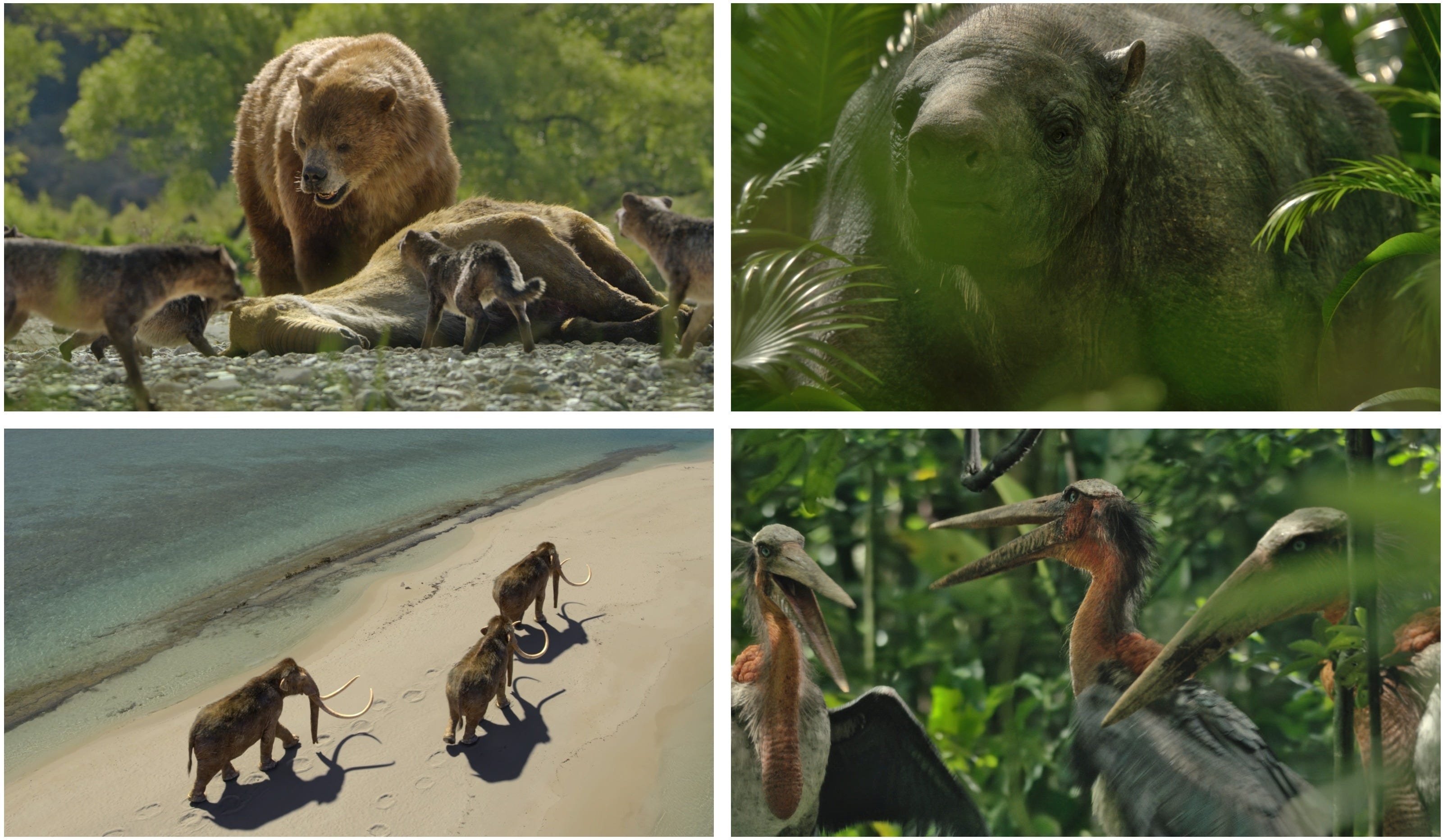
We begin this episode with a tranquil scene of ‘the biggest bear that has ever lived’, Arctotherium angustidens, waking up from a nap. It goes unmentioned in the script, but Arctotherium and Arctodus’ (we’ll see him in the finale) closest living relatives are spectacled bears. In my opinion, this relationship could’ve been better-reflected in Arctotherium’s design, like in this reconstruction by acclaimed palaeoartist Gabriel Ugueto. After the big bear rouses from his slumber, he chases a pack of Protocyon (only referred to as ‘wild dogs’ in the script) away from a Macrauchenia carcass. That’s Macrauchenia fatality number two, for those keeping count. This scene is fine overall, but there are a few discrepancies. The script introduces Arctotherium as a recent arrival to Central and South America, one who is poised to overthrow the endemic apex predators, Protocyon. The first problem is that Arctotherium migrated to South America via the Isthmus of Panama during the late Pliocene18, not the Pleistocene. Furthermore, it was the <100kg A. wingei who made this journey, a far cry from the absolute unit A. angustidens. It’s also possible that Protocyon originated in North America, as canids were among the fauna to make the great migration starting in the late Pliocene. The scene does a decent job of establishing the concept of the Great American Interchange for the audience, but the aforementioned errors make it slightly muddled in my opinion.
The next sequence stars an unexpected animal: a variegated squirrel, native to Central America. Despite being an extant species, the squirrel is CGI, necessitated by the specificity of how it interacts with its environment. The other star of this scene is Eremotherium, who really puts the ‘giant’ in giant ground sloth, weighing in at over six tonnes. Per a 2025 study by Deak et al., populations of Eremotherium living in tropical regions likely had very sparse fur19, which is beautifully restored in the model here. While some earlier studies suggested that Eremotherium may have been amphibious like a hippopotamus, a 2025 paper by Dantas and Oliveira refutes this20 through comparing their bone compactness with that of the semi-marine ground sloth Thalassocnus. The variegated squirrel is introduced exploring a new environment, populated by various live-acted extant animals, ranging from toucans to spectacled bears. He takes an interest in some cannonball fruits, which the script claims he has not encountered before. Soon enough, Eremotherium arrives to feed on the fruits, and ends up dropping several of them on the forest floor. After the squirrel dodges the falling fruits, he finally manages to snack on one, upon which Hiddleston proclaims, “It tastes awful.” The variegated squirrel effectively juxtaposes the huge size of Eremotherium throughout, highlighting just how massive the latter is by contrast. While Eremotherium is delightful to see, this sequence feels rather too much like a skit for my liking. I would wager that the squirrel’s fixation on the cannonball fruits is intended as an homage to the acorn-obsessed squirrel Scrat from the Ice Age films; it’s amusing enough, but a little too cartoonish for a documentary in my opinion. There’s also the small issue that Eremotherium probably didn’t eat a lot of fruit21, but that’s bordering on nit-picking, even for me.
Continuing the focus on xenarthrans, the next sequence features a mother and son duo of Glyptotherium, the first of two glyptodonts to appear in the show. Unfortunately, they are only referred to as ‘Ice Age armadillos’; modern armadillos were present during the Pleistocene, making this description redundant. It also understates how different glyptodonts were from their living relatives, being heavily-armoured, grazing herbivores more akin to ankylosaurs than to other armadillos. Glyptotherium is an appropriate choice for this sequence, as it is among the few glyptodonts whose fossils are known from outside of South America. The youngster (fun fact: baby armadillos are called pups) is likely based on a 2015 study that described juvenile specimens from Arizona22. The mother briefly gets her carapace stuck between two rocks, which isn’t as funny as the script thinks it is. In search of water, the duo soon encounter a small herd of Columbian mammoths, and they are intimidated into retreating by an adult male. This is an odd detail, because fossil assemblages indicate that Columbian mammoths travelled in female-led herds23, much like living elephants, whereas bulls are presumed to have lived separately. The Columbian mammoths are depicted with sparse, coarse hair; no soft tissues from the taxon are known, but this is plausible enough. Hiddleston tells us that these mammoths are ‘highly intelligent’, and while that is almost certainly true, I would’ve preferred the scene to showcase their intelligence, as opposed to just telling us. This is more of a problem because their ostensible big brains are of no relevance to their role in this segment, so it feels a bit like an afterthought. If the sequence ended with the mammoths enjoying a drink from the river, I wouldn’t take much issue with it as a whole. Alas, it continues…
The mammoths mistake a swimming baby Glyptotherium for a crocodile and promptly haul ass from the riverbank.
So, this is the crocodile fake-out scene that I mentioned earlier. It goes without saying that I’m not a fan. Surprisingly, the idea that Glyptotherium was semi-aquatic is not without merit. Some studies involving isotopic analysis have suggested that a fair portion of their diet consisted of aquatic vegetation24. Whether or not they were good swimmers is a different matter, but that’s ultimately tangential to the point. If Hiddleston is to be believed, Columbian mammoths are ‘very scared’ of crocodiles. Because of their less-than-stellar eyesight, this causes them to panic when they see the baby Glyptotherium swimming in the river, which allows he and his mother to have a drink. My problem is that the scene frames it as though the young Glyptotherium is deliberately exploiting the mammoths’ alleged croc-phobia in order to scare them off, and I don’t need to explain why that’s not realistic. The overly-jaunty soundtrack doesn’t help, as it feels like the music is beating you over the head with the fact that the scene is supposed to be funny. This could’ve been left on the cutting room floor, and nothing of value would have been lost. In fact, it could’ve allowed us to spend more time exploring island ecosystems.
Speaking of, New Lands’ next destination is the archipelago of Indonesia. I believe this segment takes place on the island of Sumba, but don’t quote me on that. Hiddleston explains to us that the Pleistocene’s variable sea levels have ‘marooned’ some formerly mainland animals on islands. He then elaborates that a common survival strategy for said animals is to become smaller over time, a phenomenon known as insular dwarfism. Stegodon is the main star here, and it is a prime example of this phenomenon25. As Hiddleston states, an adult of this species (I think it’s S. sumbaensis, based on promotional material) was ‘just three feet tall’. The two Stegodon stars of this sequence are a mother and her ridiculously cute baby daughter. My only critique of their portrayal is that evidence suggests that Stegodon were social herding animals26, much like elephants. The youngster becomes distracted by a butterfly, and chases it through the forest. This catches the attention of ‘a six-foot meat-eater’, the adjutant stork Leptoptilos robustus. The bird’s beak clattering is reminiscent of my beloved Hatzegopteryx in season two, which I’m confident was intentional. Their piercing blue eyes combined with their slow, deliberate movements lend them an undeniably eerie, wraithlike quality. The Stegodon calf tries to hide in some tree roots, only for another two Leptoptilos to swoop in; unlike their azhdarchid predecessors, however, their attempt at infanticide ends in failure. The mother Stegodon bravely charges at the three storks, allowing her daughter to escape to safety. As the two proboscideans flee, Hiddleston describes the island as ‘a world where birds can eat elephants’. I’m unsure if this was by design, but I found myself reminded of a memorable line from the first episode of Walking with Beasts, “This is a world where birds eat horses.” This is one of my favourite sequences in New Lands, but it feels slightly rushed in my opinion. Spending a minute or so longer here could’ve done wonders to help familiarise the audience with this unique ecosystem.
The following and final segment of New Lands is absolutely its saving grace, if you ask me. As we return to South America, we meet an animal whose ancestors were the continent’s apex predators for tens of millions of years…
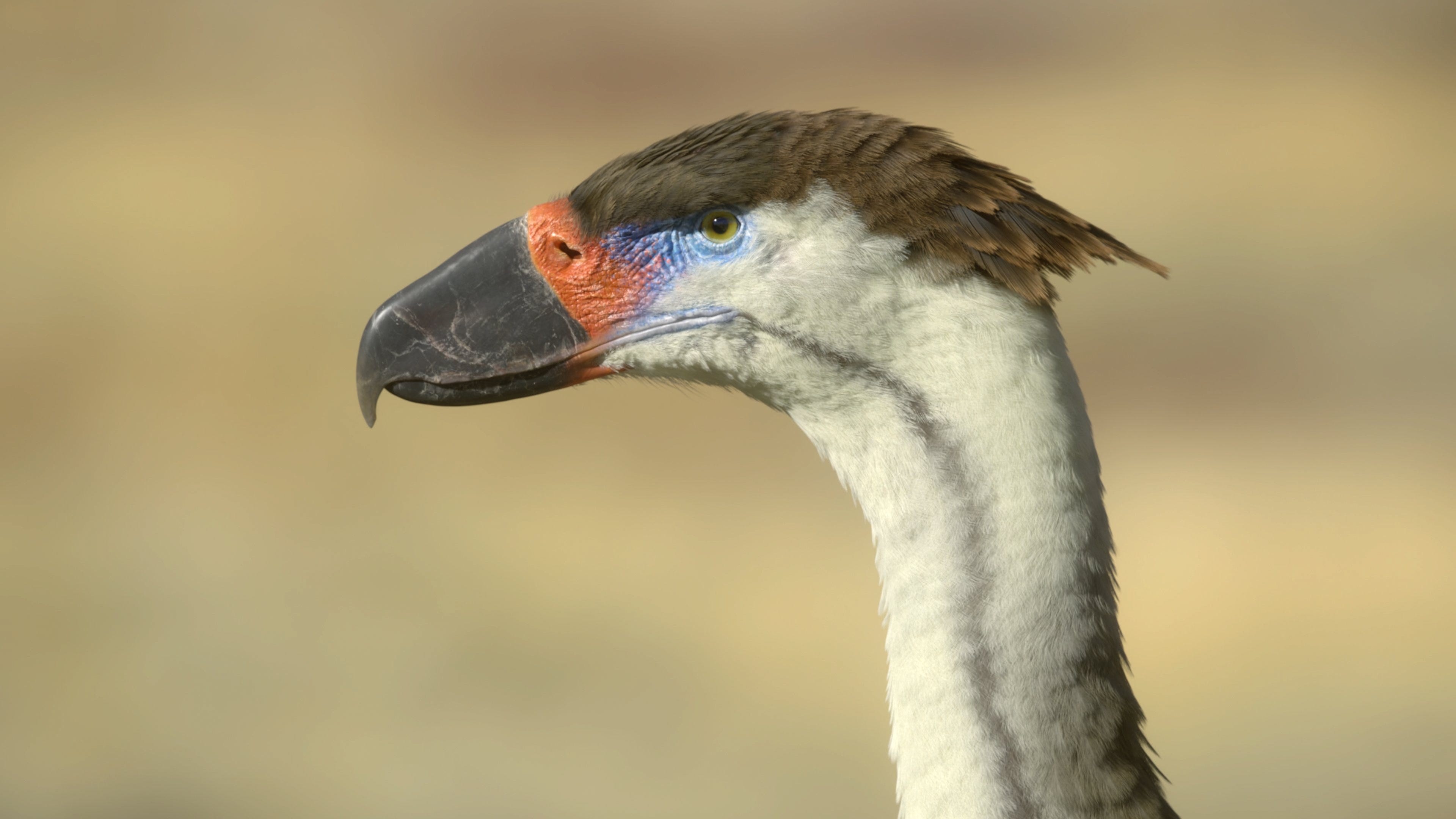
Terror birds.
The two brothers we are introduced to are psilopterines, a group of terror birds characterised by their smaller size and more gracile build when compared to the likes of Titanis or Kelenken. As Hiddleston notes, this clade of terror birds are ‘maybe not that terrifying’, but they are lovely to see all the same. Unless I’m mistaken, I think these are the first psilopterines to feature in any major palaeo-media production. Some viewers, myself included, were hoping to see their larger cousin Titanis in North America, but I think the novelty of the psilopterines makes up for it. They are accurately restored with dromaeosaur-like sickle claws on their second toes, indicated by footprints found in Argentina27. The closest living relatives of phorusrhacids are seriemas, which have a broadly similar build to the psilopterines, and it’s evident from the way the latter are animated that the team at Framestore used seriema footage as a point of reference when working on them. Hiddleston explains that food is scarce, and although the brothers normally hunt together, these trying times have led them to quarrel with one another. After a brief squabble, one of the brothers notices Smilodon populator nearby, and decides to follow him. “Why do the hard work when someone else can do it for you?” Hiddleston asks. In popular media, phorusrhacids are often relegated to scavenging Smilodon’s leftovers. While this scene may seem like another example of that, the way it is framed makes it clear that the birds’ behaviour is both opportunistic and a showcase of their intelligence. Despite their earlier dispute, the psilopterine’s brother joins him in following Smilodon. Soon enough, the brothers’ patience pays off, as the big cat makes a kill.
I’ll give you three guesses as to which animal falls prey to Smilodon in this scene:
A toxodont
A tapir
Poor, poor Macrauchenia
Yeah, it’s Macrauchenia. What else would it be?
It is after Smilodon has made his kill that the terror birds’ cunning comes to the forefront. Although they aren’t necessarily working together, the two brothers take turns snatching meat from opposite ends of the Macrauchenia carcass, leaving Smilodon at a loss for how to deter them both at once. In Hiddleston’s words, “The king has been outsmarted by a couple of birds.” This scene may not seem like anything special, but after decades of seeing phorusrhacids being overshadowed and sometimes even hunted by big cats in popular media, it’s hugely refreshing.
On the off-chance that it wasn’t self-evident, this is my least favourite episode of Prehistoric Planet: Ice Age. There are elements that I enjoy, such as the portrayal of the psilopterines, but much of the episode is hindered by problems with the script. Despite being the primary focus of the episode, the Great American Interchange is both underexplained and underexplored, partially due to how vague the geography tends to be (a recurrent issue with the season that I have already discussed). The exploration of island ecosystems is also disappointingly brief and limited in scope. There’s not much else to say about this one.
Desert Lands
The third episode, Desert Lands, explores the aridification of Australasia and South America, and the impact this climate change is having on the fauna.
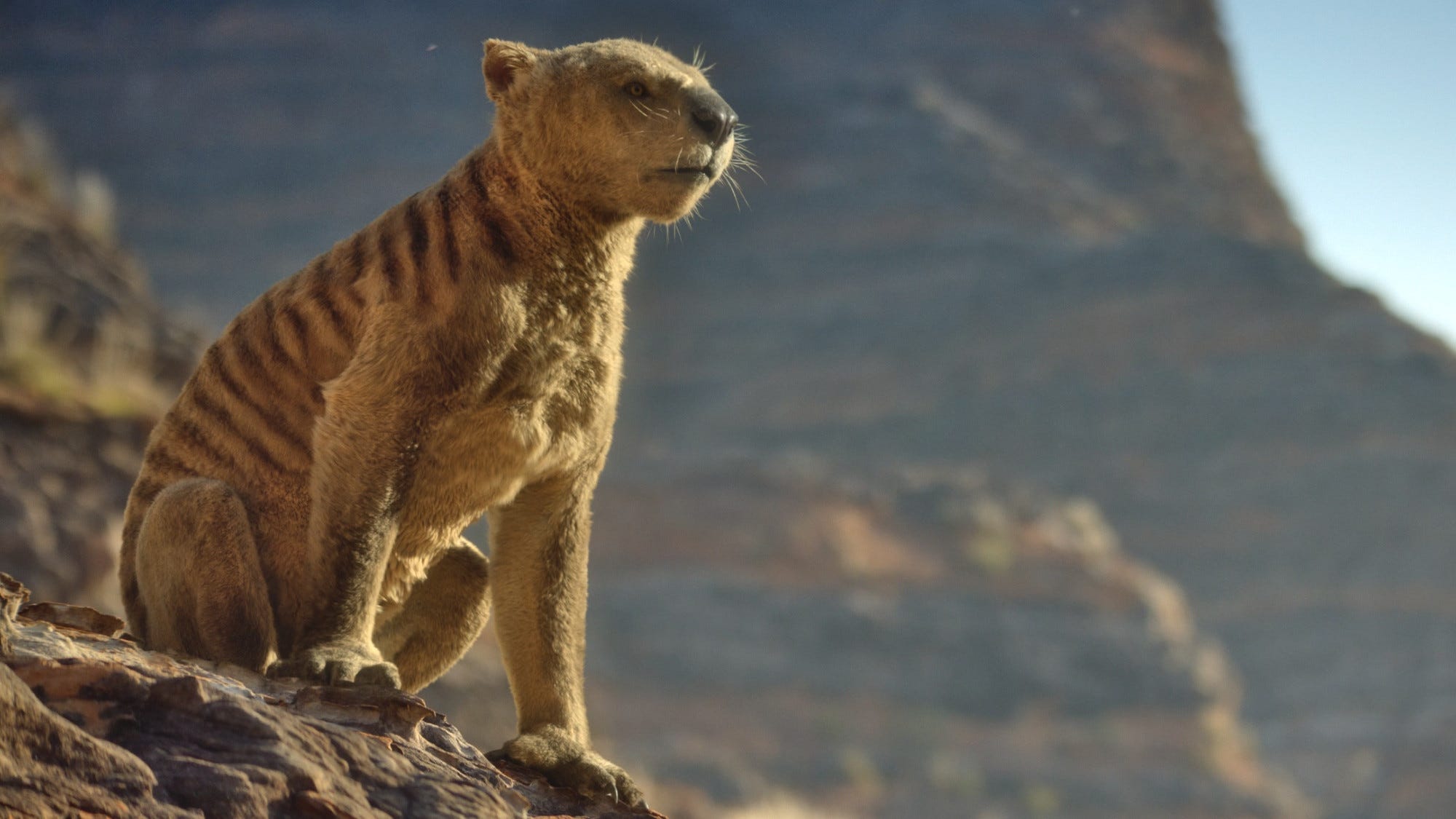
Thylacoleo are perfect. I adore them, and will hear no criticism of my flawless reasoning. Thank you.
I love this episode for the most part, but there is one issue I’d like to highlight before I start gushing about it. The script significantly overstates the severity of the aridification that the episode is centred around. I don’t profess to be an expert in palaeoclimatology, so I’ll link this very in-depth blog post by Tony of Prehistoric Passage to help explain. The short version is, what is portrayed here is grossly oversimplified. In fact, it may be a misattribution to state that the increasingly dry climate was the result of glaciation, as this has been suggested to be linked to the decline of certain types of vegetation instead28. Moreover, glacial periods were not uniformly characterised by aridity29, nor was this aridity present everywhere. This is notable during the segment on the giant moa, as the male is described as having to cross a desert to find a mate. There is no evidence that New Zealand experienced the kind of desertification depicted; it would have been more accurate to show the moa having to cross grasslands or scrublands30. Overall, the show takes an overly simplistic and outdated approach to climate science in this episode, which is a shame, because the rest of Desert Lands is great.
While this episode’s primary setting is Australasia, we begin our adventure in the Andes, where we meet a mother Diabolotherium and her young offspring. The two of them have sought shelter from predators in a cave, but the mother is now growing hungry. In order to find food in this arid environment, she is forced to embark on a perilous journey, scaling the uneven rock-face of a mountain to feed on some of the vegetation that grows near the peak. This is consistent with the high-altitude palaeoenvironment that Diabolotherium is known to have inhabited, and their rock-climbing capabilities are also consistent with their anatomy31. For simplicity’s sake, I’ll discuss both of the scenes focused on this animal here, because they form a straightforward sequence of events when put together. When we return to Diabolotherium later in the episode, she is desperately trying to dodge an attack by some teratorns, large birds of prey related to New World vultures. Clinging to the side of the cliff and with her baby on her back, she can do nothing to defend herself. The soundtrack adds a lot in this scene, as it effectively heightens the tension of what already feels like a hopeless predicament for Diabolotherium. The mother loses her grip and falls offscreen, followed by around ten seconds of total silence as we wait to find out her fate. Miraculously, she and her baby survive and make it back into their cave, and the mother makes a heroic charge at the teratorns as they attempt to follow them. Overall, the scenes featuring Diabolotherium are well-directed and entertaining, but they feel somewhat disconnected from the wider theme of aridification present throughout the rest of this episode.
Rewinding to earlier in Desert Lands, the first sequence after the opening credits introduces us to Moloch horridus, better-known as the thorny devil. I can’t tell whether it’s CGI or not, which speaks to the quality of the effects on display throughout the season. Hiddleston explains that various animals have come up with ‘tricks’ to survive the increased aridification of the interglacial period, with the thorny devil being able to absorb water droplets through its skin. Then, the real stars of the sequence arrive: a herd of female Diprotodon. They are restored with impressively big noses, indicated by extensive frontal sinuses in their skulls32, as well as a much leaner build than I am accustomed to seeing in other reconstructions. As Hiddleston notes, their ‘trick’ for surviving in their arid environment is to migrate, likely inspired by a 2017 study by Price et al. that found evidence of migratory habits for the taxon33. Them living in sex-segregated herds is also supported by fossil material34, further demonstrating how rigorous and well-researched their depiction in the show is. While a lot of media portrays marsupials as less intelligent due to them having a lower brain-to-body-size ratio than placentals, Prehistoric Planet: Ice Age subverts this trope wonderfully. The matriarch of the herd is stated to have an exceptional memory, being able to remember the path to an oasis in the desert. When she succumbs to the elements, her daughter succeeds her, following one of the show’s rare scenes of combat; this is portrayed realistically, as neither animal is trying to seriously harm the other, and its brevity is much appreciated. At first, it looks as though the matriarch’s daughter has led the herd into certain doom, mistaking a mirage for a real watering hole. However, she uses her incredible sense of smell to detect water underground, and is able to dig it up and allow her herd-mates to drink. This sequence is honestly fantastic, including its incorporation of extant fauna like the thorny devil and the wedge-tailed eagle, and I love how it challenges the preconceptions that an audience may have about marsupial behaviour and cognition.
Next up, we’re introduced to the animal that I was absolutely the most excited to see, and that’s Thylacoleo. An interesting detail is that this episode is how I learned that they were closely related to koalas, per a study published in November 202535 that I missed in the run-up to the show. I could talk about them all day, but in the interest of being relatively concise, I’ll link to this blog post from Darren Naish that discusses these delightful animals with more eloquence than I could manage with my bias towards them. I don’t think it’s an exaggeration to say that this is the best portrayal of Thylacoleo ever put to screen, with their colour patterning being directly based on their depiction in Aboriginal rock art36. Portrayed as gregarious, we meet a group of them on a rocky outcrop, including some very cute babies, referred to as ‘cubs’ rather than joeys (not sure why). According to Hiddleston, the forests Thylacoleo once preferred are shrinking due to aridification, and the scrublands emerging in their place are populated by more dangerous prey. These include the giant short-faced kangaroo Procoptodon goliah, the largest kangaroo that we know of, whose remains are known predominantly from semi-arid environments. Being ambush predators, Thylacoleo have a difficult time trying to sneak up on their prey with minimal cover, and the Procoptodon see them coming. A chase begins in dramatic slow-motion, as Hiddleston explains that Procoptodon are not fast runners37, “but the marsupial lions… are even slower.” The reveal that both animals involved are relative slowpokes is well-executed, and I’ll admit that it made me chuckle. Thylacoleo’s inferred low running speed was likely based on a 2018 study by Wells and Camens38; as Hiddleston says, they’re ‘more koala than lion’ in this instance. Unfortunately for my darling Thylacoleo, they are unable to match the kangaroos’ pace, and to add insult to injury, one of them gets kicked in the face after attempting a tackle.
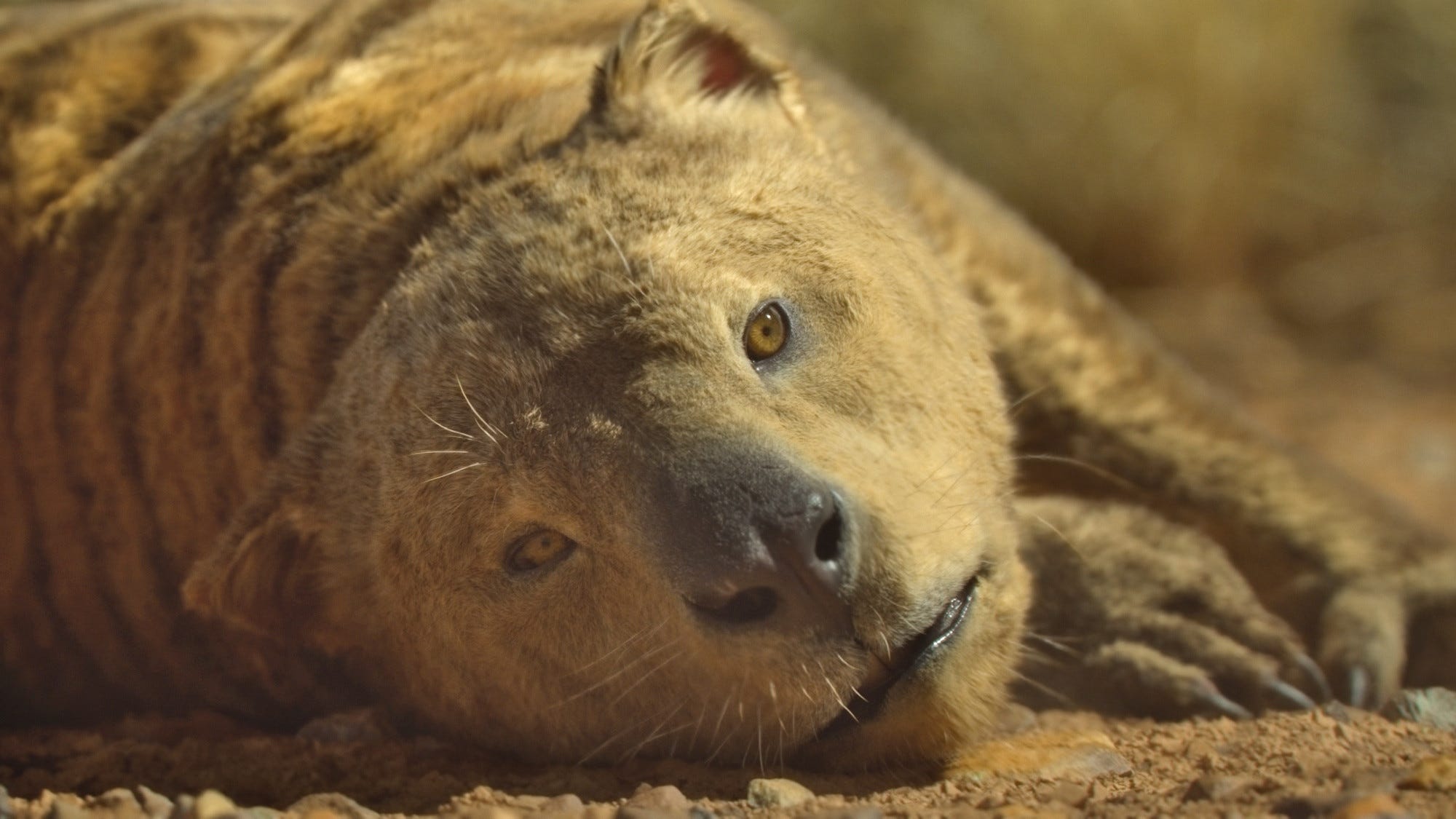
Defeated, the group of Thylacoleo return to their rock - except the mother of the cubs, who is mysteriously absent. We’ll see her again later. As much as I love Thylacoleo, I can’t deny that they’re very strange animals. This scene does an excellent job of establishing what they are to an audience that may be unfamiliar, while not taking itself too seriously. A carnivorous koala is, after all, an inherently funny concept, something that Australian viewers will know all too well. The comedic scenes sprinkled throughout this season are hit-and-miss for me, but the reveal of Thylacoleo’s underwhelming running speed is among the more successful ones. As we’ll see near the end of the episode, the script’s mention of how Thylacoleo prefer forested environments sets the stage well for their second scene, which might be my favourite in the whole season. The scene is also thematically congruent with the rest of Desert Lands, given that we are told that Thylacoleo are struggling to find prey as a result of the increasingly arid conditions. The only thing I would change about this sequence is that Thylacoleo’s size could have been made explicit; T. carnifex was around the size of a lioness, but they look tiny next to Procoptodon. Perhaps juxtaposing them with some smaller contemporaneous fauna could’ve visually communicated their size without stating it outright. Another issue is that some studies have suggested that Thylacoleo was well-adapted for open, arid environments39, as opposed to being a displaced forest specialist as portrayed here. These are minor critiques, though, and I thoroughly enjoyed this sequence all the same.
Alright, I’ll talk about the short king moa now.
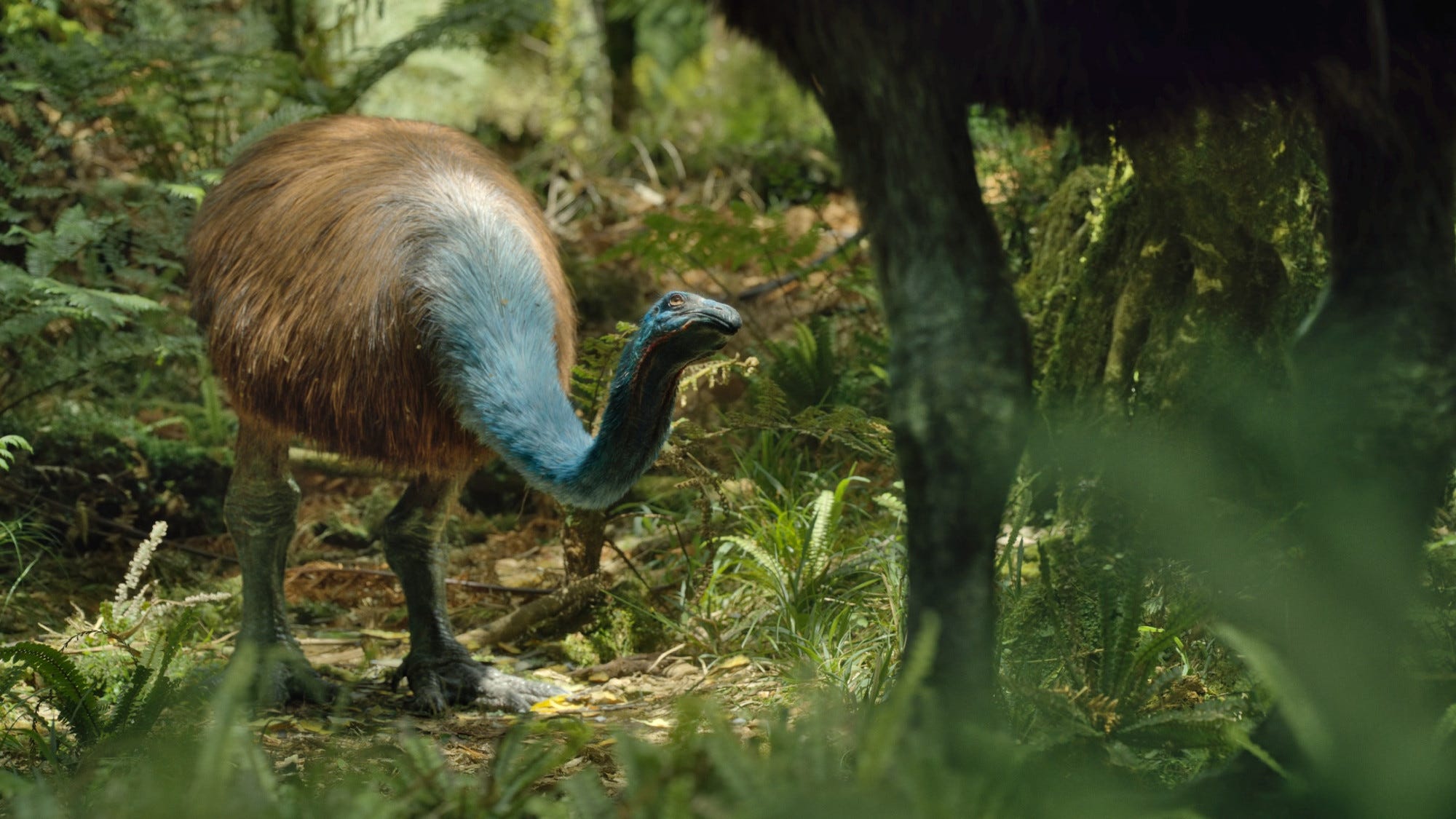
As mentioned previously, Prehistoric Planet: Ice Age is intended to be family-friendly edutainment, and this drives many of the creative decisions that we see play out on-screen. Whimsy and charm are critical ingredients in the season’s recipe, and if you ask me, they are most apparent and most effective in the sequence that showcases Dinornis. Distantly related to the tinamous of the Americas, the giant moa is well-known for its remarkable sexual dimorphism, with females being up to twice the size of males40. Some other palaeognaths, such as cassowaries, also have larger females, but the difference is not nearly so extreme. After briefly crossing paths with a live-acted dung beetle, the hopeless romantic male moa enters a forest, where he proceeds to call for a mate. Upon hearing an answer, he ‘looks a bit nervous’; the female moa is then introduced, first through her booming vocalisations, followed by a close-up of her massive feet, accompanied by heavy breathing and ominous music. She towers over her prospective partner, and we are treated to several wide shots of the pair to really hammer home the size difference. “To woo her, he needs to look as small as possible,” Hiddleston says. After he performs an extremely endearing dance, the female allows him to mount her, which looks hilarious. He then assumes the role of dedicated malewife, jumping up to show her which food she should eat (again, absolutely adorable), and chasing off a rival male who has eyes for his new lady friend. We then see her lay the egg he has sired, which he proceeds to watch over as she leaves for greener pastures; evidence from D. novaezealandiae indeed indicates that the males were responsible for egg care41. Safe to say, I love this sequence. It’s one of very few examples of courtship in this season, and they definitely picked the right animal to do this with. I have zero complaints.
If you have trouble wrapping your head around the idea of a carnivorous koala, the next animal featured in this episode will blow your mind: Propleopus, a meat-eating kangaroo42. Well, it’s technically a rat-kangaroo, but who’s counting? This is one of the more obscure animals featured in the season, and due to the paucity of fossil material, its appearance is largely speculative. You’re probably tired of me saying this by now, but it would be remiss of me not to note that Propleopus are very cute. In this sequence, we are introduced to a mother and her two joeys, who are twins. One of the twins tries and fails to catch a scorpion, before turning his attention to some lizard hatchlings. These little guys are juvenile Varanus priscus, more famously known as megalania, the largest terrestrial lizard from the fossil record. Like Propleopus, V. priscus is known from fragmentary remains, and its appearance draws a lot of inspiration from its closest living relative, the Komodo dragon. Soon, an adult V. priscus arrives, stated to be twenty feet in length. The only issue with the model is that it has vertical slit pupils, which no monitor lizards have, but it is what it is. In true Komodo dragon fashion, the adult is quick to indulge in a bit of cannibalistic infanticide. You know, as a treat. Despite considering eating the babies himself, Propleopus looks downright horrified by this, which got a snicker out of me. The huge lizard then pursues Propleopus, and as someone who has spent time around Komodo dragons, it’s evident that their movements were painstakingly referenced by the animators. The young Propleopus manages to escape V. priscus’ jaws by leaping to safety, whereupon he returns to his mother. This sequence is dynamic and entertaining, but it’s a fairly brief, and part of me wishes that we got to spend more time with V. priscus in this episode.
And now that V. priscus has had their cannibalistic fun, we can return to another scene with the best animal in the show.
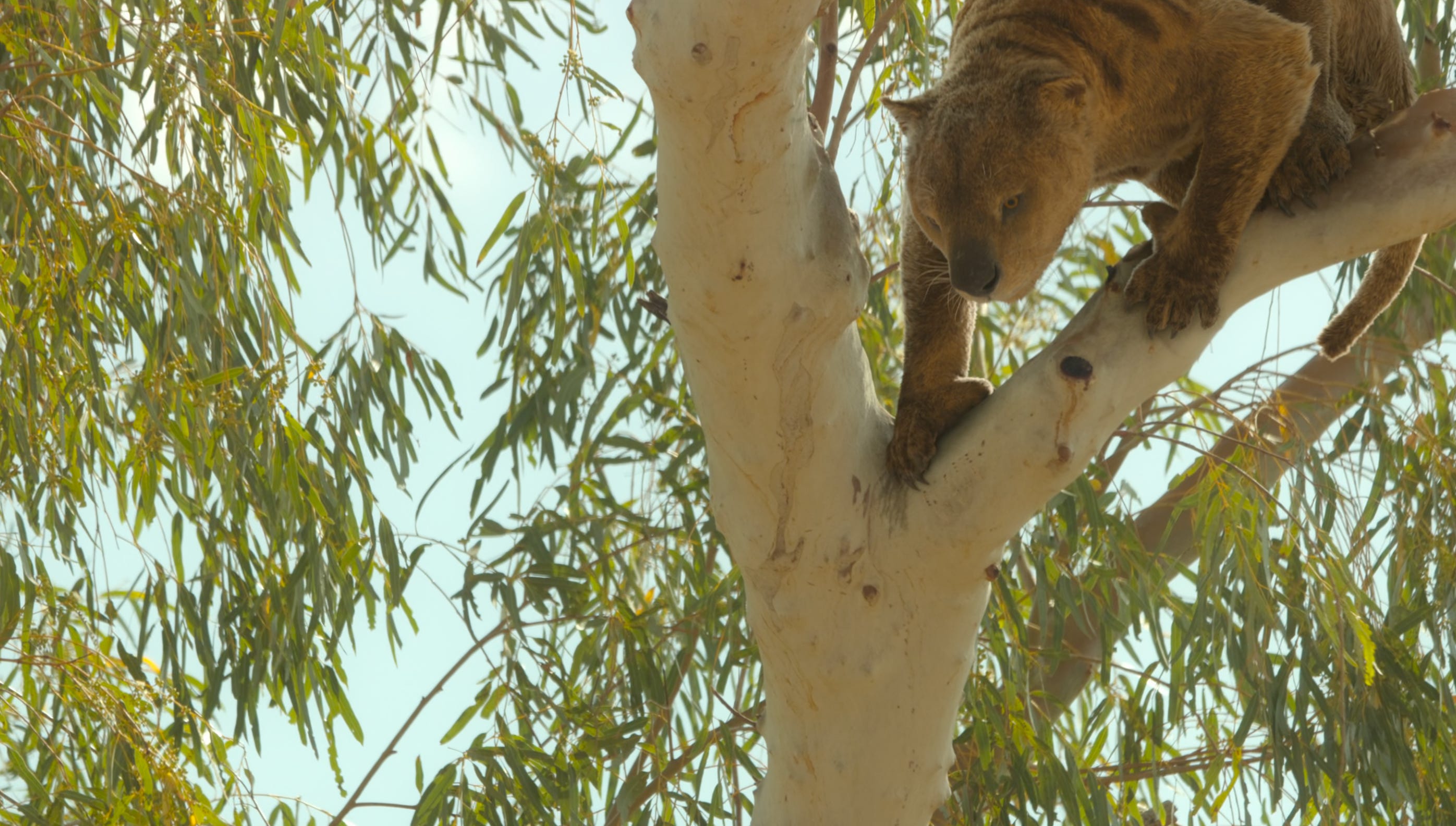
So, when Prehistoric Planet: Ice Age was first announced, I had precisely one wish. I desperately wanted to see Thylacoleo pounce on their prey from the treetops, like this leopard in Planet Earth III. While this may seem fanciful, a 2016 study by Arman and Prideaux indicates that Thylacoleo were adept climbers43, and I had my fingers crossed that this aspect of their behaviour would be brought to life in the show. Suffice to say, when I caught a glimpse of that exact scenario in the trailer, I was overjoyed. I may have squealed like a child, but you’ll never prove that in a court of law, and that’s all that matters.
As the scene begins, we are reminded that the young Thylacoleo’s mother is missing, but Hiddleston quickly clarifies that she has not abandoned him. We then see the mother lying in wait thirty-five feet up a tree, keeping a watchful eye on a group of Procoptodon seeking shade beneath her. It is explained that Procoptodon lick their wrists in order to keep cool, which is something that modern kangaroos do as well. In slow-motion, Thylacoleo leaps down to the ground, and manages to tackle and kill the Procoptodon joey that she and the other Thylacoleo were eyeing earlier in the episode. The question is: would Thylacoleo realistically survive this drop? Nine times out of ten, probably not. Leopards, especially males, often die while attempting the same strategy, and they weigh less than some of the smaller Thylacoleo specimens we have on record. All in all, it’s unlikely that her first attempt at this would culminate in anything less than failure and some broken bones. Here’s the thing: I don’t care, because it’s incredibly cool. It allows the storyline of Thylacoleo - and, by extension, Desert Lands as a whole - to end on a triumphant note. In spite of everything, life finds a way, even under the harshest conditions.
Although the oversimplified climate science is a drawback that I can’t ignore, Desert Lands is probably my favourite episode of this season. I don’t need to tell you that Thylacoleo is a big part of that, but the rest of the episode is equally enjoyable. The moa sequence is definitely a highlight, one that harkens back to the memorable Carnotaurus courtship scene from season one, albeit with a positive outcome for our dashing male lead this time. Part of me wishes that the whole episode had been focused on Australia and New Zealand, as I have a serious soft spot for the Pleistocene fauna of Australasia, but that’s not a criticism of the Diabolotherium sequence so much as it is my own bias talking. What we got was fantastic, and this is the episode that I most looked forward to rewatching for my review. I don’t doubt that I’ll rewatch it again in the future, probably more than once.
Grass Lands
Episode four is titled Grass Lands, and includes one of the most memorable segments in the season, if not the whole show.
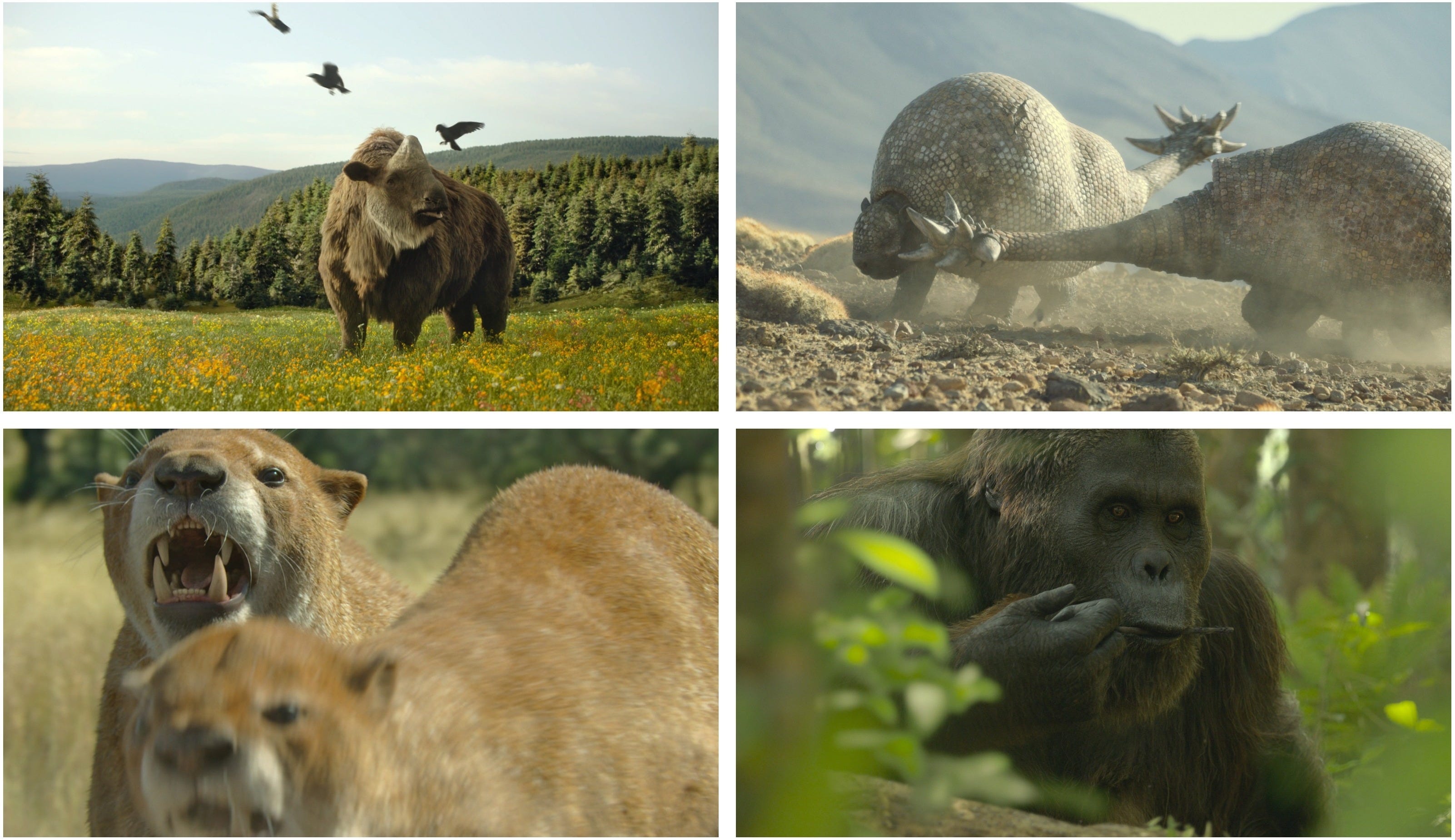
The scene: a picturesque alpine meadow, starring a female Elasmotherium sibiricum. This is a gorgeous set-piece, with a breath-taking landscape bolstered by a majestic Elasmotherium. Per a 2021 study by Titov, Baigusheva, and Uchytel’, she is restored with a short, blunt horn on her forehead44, as opposed to 2-metre-long keratinous horn commonly seen in earlier reconstructions. Elasmotherium is among the most photorealistic animals in the show, with a perfectly imperfect coat of dense, woolly fur that I dearly want to condition and detangle for her. As far as I’m aware, there’s no evidence to indicate the potential social habits of Elasmotherium, but they are portrayed as solitary animals here. After the opening credits, Hiddleston informs us that Elasmotherium is plagued by blood-sucking ticks. For a moment, it looks as though some ravens may help her out, but alas, they just steal fur from her. She then proceeds to head upland in search of a hot mud pool to bathe in, where she encounters a male Elasmotherium. She and this male - implied by the script to be her brother - share a glorious mud bath, gossiping like old women as they do so. Compared to the high-stakes openings of prior episodes, Grass Lands begins in a much more subdued manner. For me, it’s a refreshing change of pace, though I can see how a different viewer may find it to be less engaging. The scale and charisma offered by the beautiful Elasmotherium more than compensates for the lack of excitement, in my opinion, but to each their own.
The next sequence takes us to Ethiopia, where we witness a trio of Homotherium hunting zebra. Right off the bat, I have a bit of a quibble with this. The majority of putative Homotherium material from Africa is quite fragmentary, to the extent that some have argued that the remains from Ethiopia in particular represent misidentified material from Dinofelis45, a machairodontine not closely related to Homotherium. As the cats settle down to feed, Hiddleston warns us that they will not be the apex predators of this region for much longer. Large shapes move in the tall grass nearby, and soon enough, we meet their challengers; five Enhydriodon omoensis, lion-sized land otters. The 2022 study that named this species inferred a primarily terrestrial mode of life based on stable carbon and oxygen isotope ratios46, so this is not as far-fetched as it may seem. The otters and cats proceed to fight over the zebra carcass, but being outnumbered, the Homotherium brothers are forced to retreat. A pair of Enhydriodon pups emerge to join in on the feast, at which point we are informed that, “They [Enhydriodon] are now the kings of the African plains.” Sorry, what? Yeah, it’s just one line, but you’d be disappointed if I didn’t complain about it. Implying that Enhydriodon outcompeted big cats is frankly absurd, even without taking the predator guilds of the modern African grasslands into consideration. The hypothesis of competitive exclusion simply does not make a lot of sense in this scenario, as differences in the dentition of these animals suggests different feeding strategies and therefore niche partitioning. I don’t object to Enhydriodon stealing Homotherium’s lunch, but to imply that this is indicative of the latter being overthrown as top predators is laughable. Aside from that ill-conceived line, this scene is pretty good. The tension preceding the arrival of Enhydriodon is built up well, and it’s always nice to see some under-represented taxa.
Our next protagonist is none other than Gigantopithecus, the largest primate from the fossil record. His design is a far cry from the typical upscaled orangutan depictions of the past decade or so, but still recognisably pongine. He is stated to be ‘double the weight of a silverback gorilla’, which may be outdated, if a 2019 study by Gayford et al. is anything to go by47. While it’s difficult to say for sure, it’s possible that the older size estimate was used to make Gigantopithecus seem more spectacular, and given that his size isn’t relevant to the rest of his portrayal, I’m willing to let it slide. Hiddleston tells us that the encroachment of grasslands on his former forest habitat has been ‘devastating’, which is consistent with current theories surrounding the cause of their extinction48. Gigantopithecus issues a mating bellow, but to no avail. The sound echoes throughout the landscape, emphasised by an extreme long shot of his alpine forest habitat, as it goes unanswered. Although this sequence is undeniably poignant, that doesn’t stop it from showcasing some interesting behaviours for its main star. We see Gigantopithecus using a stick to gather ants to feed on, as well as using… another stick to knock some berries down from a tree. Tool use has been well-documented in their closest living relatives, the orangutans, so this bit of speculation is plausible. He also briefly walks on two legs; I’m unsure of how reasonable this is, given that smaller gorillas struggle to sustain this mode of locomotion, but it’s not egregious. Gigantopithecus is the only extinct animal to feature in this segment, highlighting his isolation. The thorough showcase of his problem-solving skills and capacity for emotion tugs on the heartstrings, too, allowing our tragic hero to be relatable to a (presumably) human audience. After he succeeds in procuring a meal, Hiddleston notes that, “He’s still missing one thing… someone to share it with.” While it is depressing, this sequence is effective in highlighting the impact of the changing Pleistocene landscape on the fauna, and centring Gigantopithecus as a protagonist helps the audience connect with this theme.
“Gigantopithecus isn’t the only one struggling to breed,” Hiddleston tells us. This sequence focuses on the glyptodont Doedicurus, but that’s not the most incredible thing on offer here; we see a group of Macrauchenia, and none of them get mauled to death! Jokes aside, Doedicurus is described as being ‘the size of a car’, which is incidentally (or perhaps not) the exact same comparison used in Walking with Beasts. A lovelorn young male is hoping to find a partner, but because he has poor eyesight, he must rely on his other senses. Would you believe me if I said he uses his sense of smell to track down a female by following a trail of dung? Well, of course you would, because that’s ridiculously specific. As it transpires, a 2023 study indicates that Doedicurus had a well-developed olfactory bulb49, meaning that this behaviour is surprisingly plausible. During his quest, we see him rear up on his back legs, which is also something that Doedicurus is thought to have been capable of50. He locates his love interest soon enough, but there’s a problem; she already has a suitor. The other male is older and larger, a dangerous foe for our chivalrous hero. “But for him, she’s worth it,” Hiddleston remarks. “Males will risk their lives for a female.” The two then engage in an epic battle, swinging their spiked tail clubs at each other with tremendous force. In a way, this scene feels like a response to fans who were dissatisfied by a lack of ankylosaur combat in the first two seasons, but it’s still incredibly fun to watch. The soundtrack during this scene does a superb job of heightening the intensity, similar to the track that plays during Dreadnoughtus fight from season one. In the end, the younger male is victorious, but the outcome is not what he was hoping for, as the female rejects him. Maybe the animators couldn’t figure out how to depict glyptodont copulation without it looking absurd, and that’s honestly a fair reason. While one could argue that this sequence isn’t all that relevant to Grass Lands’ main theme, that does not detract from its entertainment value; I, for one, will never tire of seeing Doedicurus combat.
The final segment of Grass Lands reintroduces us to woolly mammoths, as a herd are having a difficult time trying to scrape by during a prolonged dry season.
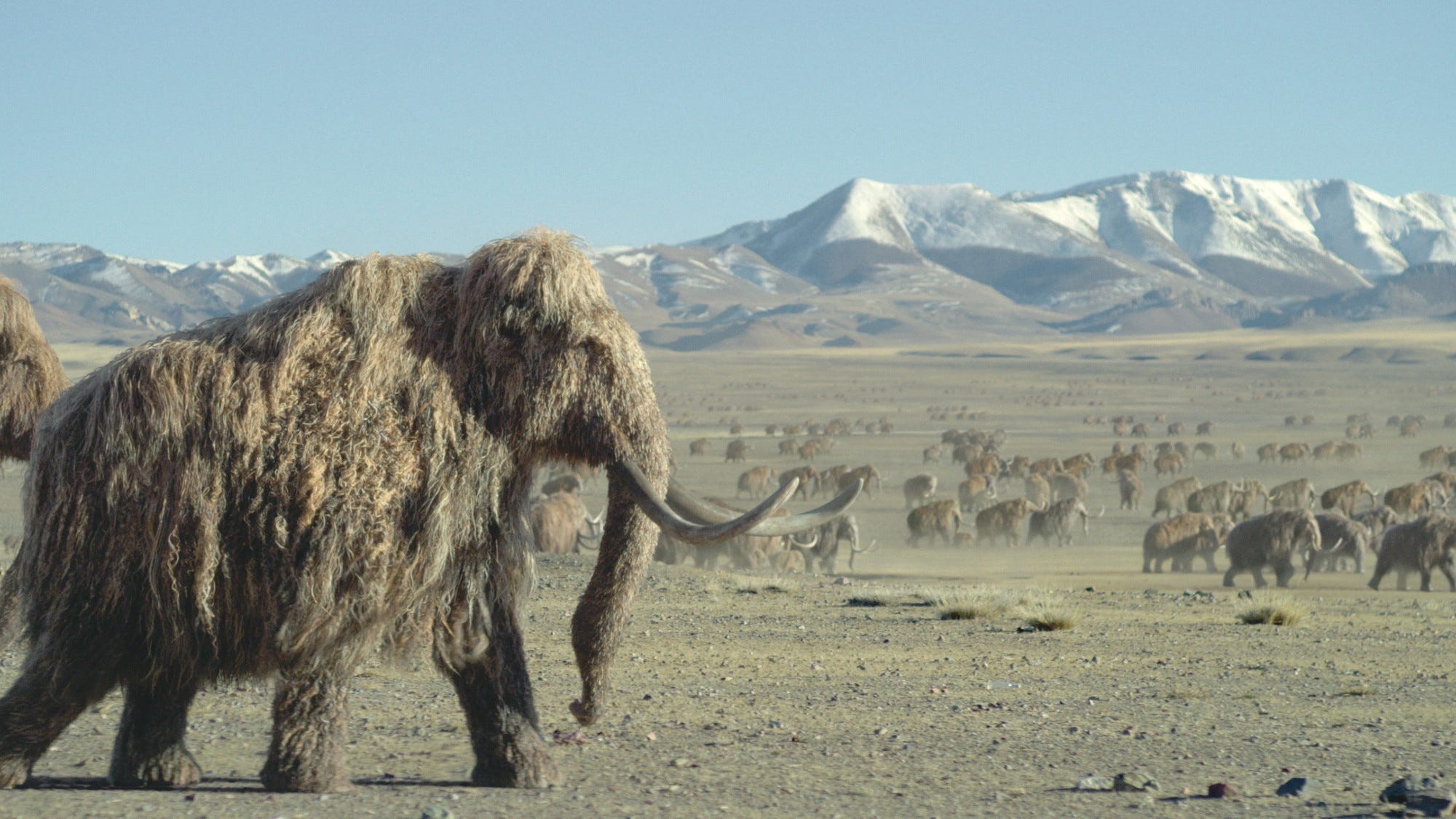
I didn’t talk much about the woolly mammoth model during their first appearance, so let’s do that now. Given that they are almost definitely the most iconic Pleistocene animal in the public consciousness, it’s crucial that the show depicts them accurately, and they’ve passed this test with flying colours51. Similar to Elasmotherium and Megaloceros, the attention to detail in the texture of their fur is extremely lifelike, and out of all the mainstream depictions of woolly mammoths I’ve seen, this model is the most faithful to both fossil evidence and cave paintings. In this sequence, we see a mother is unable to feed her calf; the drought has caused her to run out of milk, meaning that the herd must find water quickly. The herd’s matriarch uses the seismic sensitivity in her feet to detect distant rainfall. Modern elephants are capable of this, and a 2025 study by Peterson, Rust, and Helm suggests that mammoths shared this ability with their living kin52. An already risky journey becomes exponentially more treacherous when the herd is blighted by a brutal dust-storm. Unable to flee from the onslaught, the mammoths must do what they can to survive it, and the tension is ratcheted up by the soundtrack as Hiddleston warns that the calf is likely to suffocate. After the storm subsides, Hiddleston remarks, “A third of mammoth calves die before they reach a year old.” The calf has collapsed to the ground, too weak to stand. But when all hope seems lost, the rains arrive, accompanied by a triumphant swell of the orchestral score. Against all odds, the calf survives. The herd is soon joined by many more mammoths; I won’t attempt to count them all, but we see a truly impressive number of animals on-screen. While I can’t deny that the sudden rainfall is somewhat of a deus ex machina, like the Thylacoleo scene at the end of Desert Lands, its primary purpose is to allow the episode to close out on an optimistic note. Again, does anyone really want to see a cute baby mammoth die?
It’s hard to argue that the Gigantopithecus sequence is anything other than the standout of this episode (and I’ve seen several people naming it as their favourite of the season), but it has plenty of competition here. This episode strikes a good balance between spectacle and realism, handling the ostentatious Doedicurus fight and the pathos of Gigantopithecus with equal aplomb. The bait-and-switch at the climax of the mammoth segment is also well-executed, such that it doesn’t feel as though the calf’s survival cheapens what came before. That being said, it’s not all sunshine and rainbows, as several of the segments’ nominal protagonists do not get the outcome they want, which lends the episode some extra realism. For a family-friendly show, this is quite refreshing. The soundtrack, though not lacking in prior episodes, is probably at its best in Grass Lands, with a number of memorable tracks. (Praying that we get an official release soon.) Only the awkward handling of the Homotherium and Enhydriodon conflict holds it back from being my favourite of the season. And the fact that it doesn’t have Thylacoleo, obviously.
The Big Melt
All good things must come to an end. Onto the finale, titled The Big Melt…
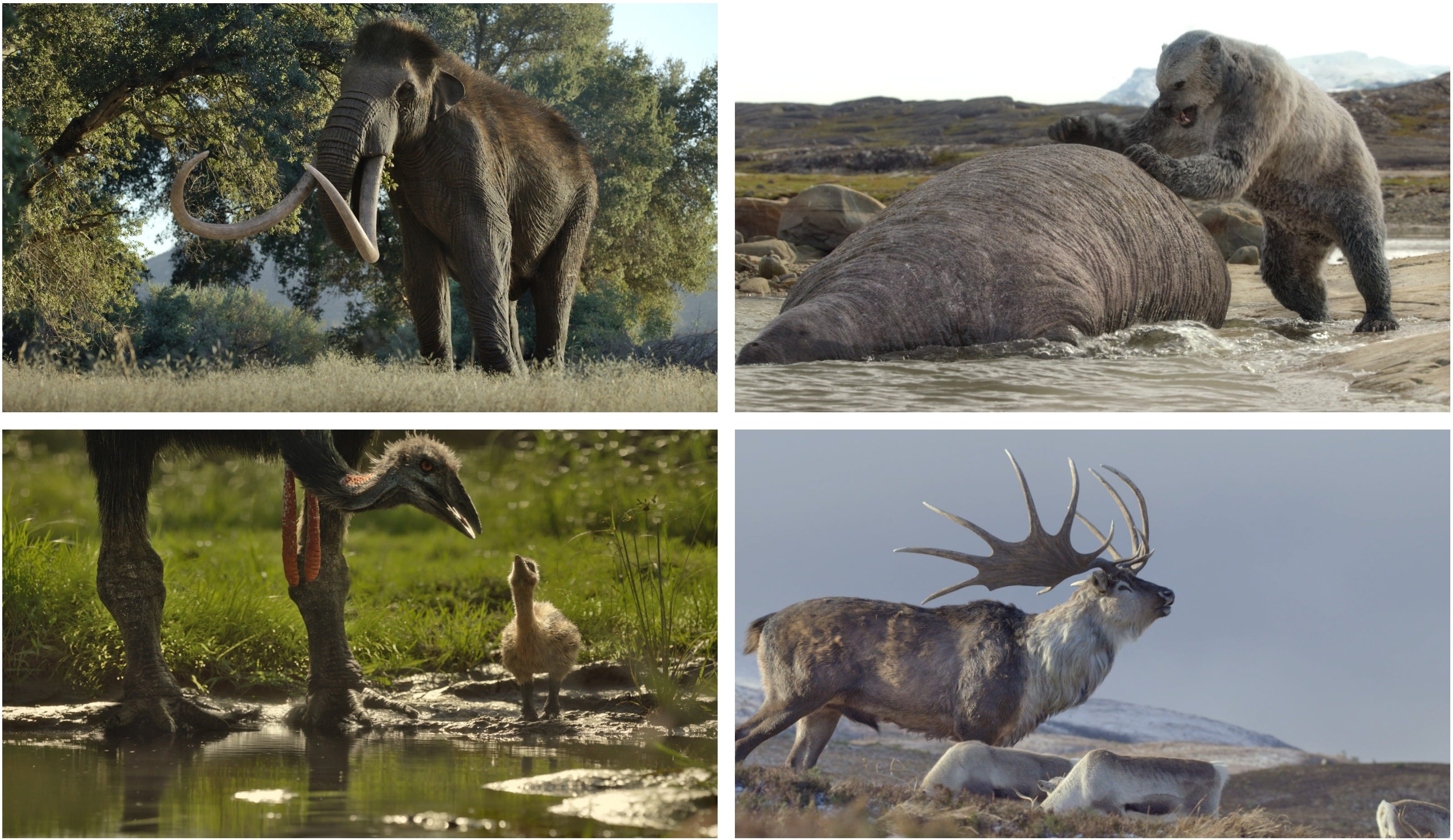
As the episode begins, we meet a family of Homotherium serum, the third and final species of Homotherium depicted in the show. This species has striking white or transparent fur with faint spots, the plausibility of which has been called into question by some reviewers. Hiddleston tells us that the cats are having a difficult time adjusting to the warming climate, which is causing their prey to become scarce. This idea is consistent with our current understanding of why H. serum went extinct53, as the youngest reliably dated remains of the species are between 12,715–12,655 years old54. “Today, they might be in luck,” Hiddleston says, as a herd of woolly mammoths pass through Homotherium’s hunting grounds. For some reason, the cats decide that it’s a splendid idea to target the largest bull in the herd. While big cats occasionally hunt elephants today, they’re far more likely to prey on calves and juveniles55, and prides of lions that attempt this typically number at least ten adult individuals56. In the latter study I just cited, only one of the 74 elephants that fell prey to the pride was a mature bull. The Homotherium family are mobbed by two other mammoths, and are forced to retreat before they can make a kill; by some grace of God, the mammoths don’t kill any of them in return. I don’t necessarily dislike this scene, but it does stretch the suspension of disbelief when it comes to believable animal behaviour for both Homotherium and the mammoths. The soundtrack and cinematography certainly redeem it to an extent, though, and it’s a far more believable portrayal of a predation attempt on mammoths than the much-maligned cave lion sequence from Life On Our Planet.
The next sequence features Prehistoric Planet: Ice Age’s only marine animal, Steller’s sea cow. Hiddleston unhelpfully describes these chonkers as being ‘the size of whales’, which could mean anything. In reality, sea cows weighed between 8-10 tonnes. The only issue I have with their depiction is that they were positively buoyant57, meaning that they could not submerge, as they are shown doing several times. They are accurately portrayed as feeding on kelp in shallow, coastal waters, as well as living in family groups, which is consistent with how they were described by Georg Steller in his 18th century documentation of them. Unfortunately, it’s not long before one of the sea cows finds himself stranded on a beach during low tide, piquing the curiosity of a marauding Arctodus simus. One of the largest bears in the fossil record, Hiddleston claims that A. simus is ‘more deadly’ than a polar bear. While this isn’t unreasonable per se, it’s worth noting that, unlike polar bears, A. simus were omnivores58. The model is excellent, as per usual, and distinct from Arctotherium in New Lands. Intrigued, A. simus approaches the beached sea cow, but it’s not long before he encounters a problem - the sea cow’s skin is an inch thick, and too tough for his teeth to puncture. As the bear becomes increasingly frustrated, Hiddleston remarks, “The bear’s attack is just an irritation, or maybe a welcome back scratch.” The sea cow looks delightfully unbothered throughout this ordeal, and is able to flop back into the ocean when the tide rises once more. To say that A. simus is furious would be an understatement. Imagine having a huge buffet in front of you that you can’t eat, and you’re then powerless to stop it flopping away at ~2 miles per hour. While one could argue that this scene doesn’t contribute to the narrative of The Big Melt, I found it hilarious. The way A. simus is hyped up in the narration makes his inability to even superficially harm the sea cow all the more amusing to watch. Plus, it’s wonderful to see Steller’s sea cow resurrected on-screen. In an ideal world, we wouldn’t need to use CGI to restore them, but I’ll stop myself there before I get too maudlin.
Tar pits across the world have yielded some fascinating fossil discoveries from the Pleistocene, ranging from Azerbaijan to Trinidad and Tobago. Among the most famous tar pits is Rancho La Brea, located in urban Los Angeles. It should therefore come as little surprise that Prehistoric Planet: Ice Age visits this location. After Hiddleston explains the perils of tar pits to the audience, a Columbian mammoth illustrates this more explicitly, becoming trapped. He bellows in distress as he realises his predicament, but he is too late to save himself. Once he has perished, the smell of his carcass attracts a family of scavengers; Smilodon fatalis59. This is the second species of Smilodon depicted in this season, and it is easily distinguished from S. populator based on its colouration and more gracile proportions. Furthermore, this scene features the only machairodontine cubs we’ll see in Prehistoric Planet: Ice Age, and - my goodness, they are worth the wait!
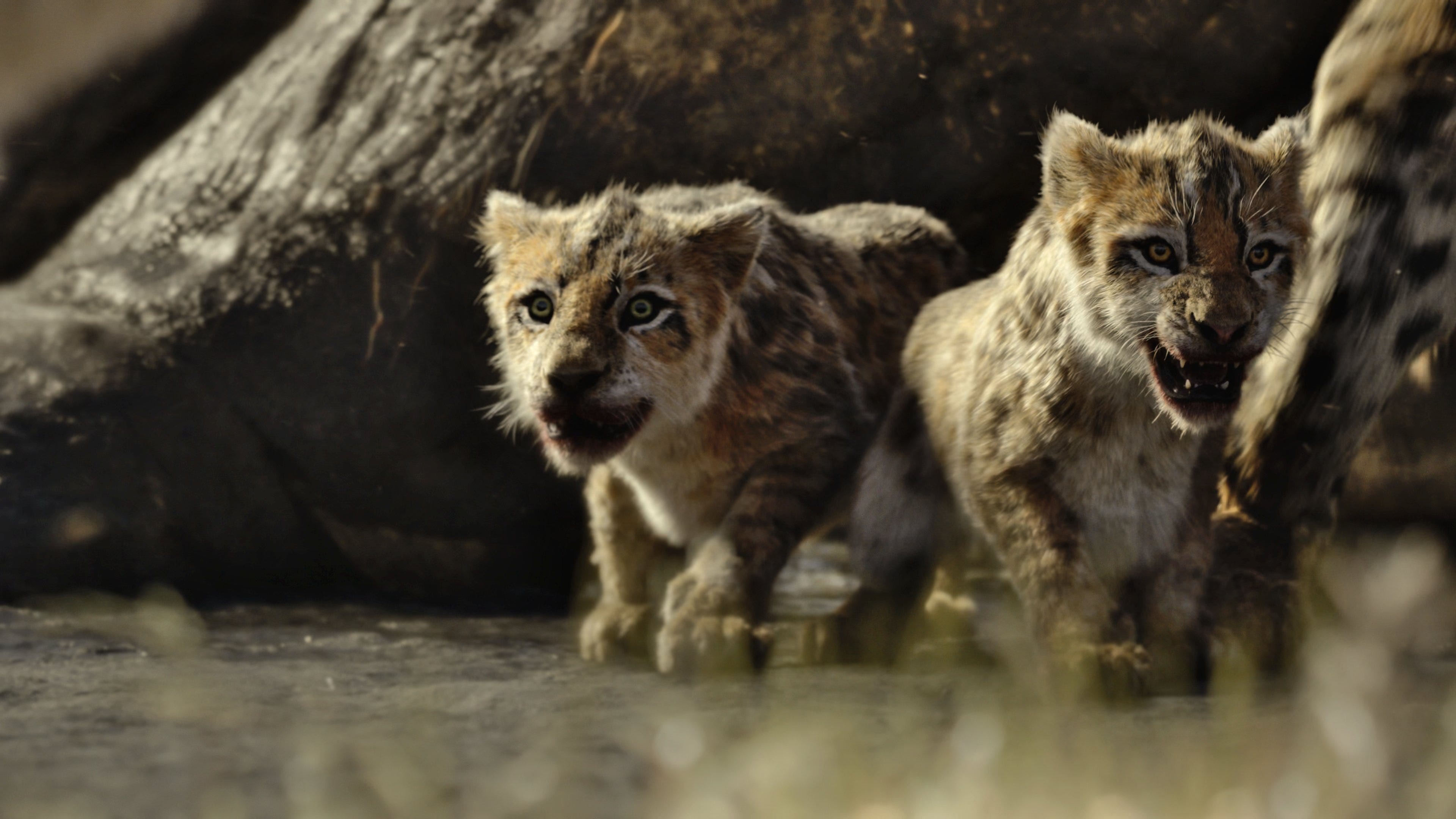
So incredibly precious. I want to adopt a litter of them right now.
Back on topic, it seems likely that the individuals represented here are based on three specimens of Smilodon fatalis found in Ecuador60, believed to be a mother and her two young cubs. While the sex of the siblings is not made clear in the script, if they are based on the Ecuadorian specimens, they’re brother and sister. The cubs meow like cheetahs, and that makes my heart very happy. They are also notably robust, which is consistent with the aforementioned material from Ecuador. Because the tar is now cool, the mother decides that the risk is worth it to scavenge on the mammoth carcass. As the cats settle down to feed, their ‘deadly rivals’ arrive - dire wolves. Their colouration seems to be inspired by golden jackals, which is definitely more realistic for their ecology than them being snow-white all over. It’s the classic cats vs. dogs trope, Pleistocene edition, but there is at least some evidence to suggest that they may have competed for similar prey. The accumulation of carcasses in La Brea suggests that dire wolves were social, and curiously, a 2008 study suggested the same of Smilodon fatalis61, which is not reflected here. The dire wolves pose a substantial threat to the Smilodon cubs, and to make matters worse, the rising temperature means that their mother is now stuck in the tar. Just as one of her cubs is grabbed, the mother summons her strength and frees herself. Her superior size allows her to fend off the dire wolves, and she and her cubs quickly seize the opportunity to escape to safety. The tables are turned, and one of the wolves is to become the tar’s next victim. “This family has been lucky,” Hiddleston explains, referring to the cats. ‘Lucky’ is an understatement. I don’t normally like the term ‘plot armour’, but I’m unsure of how else to describe this. As awesome as it is to see two iconic predators duking it out, the mother finding her strength due to the power of love is rather cheesy. Again, I don’t want to see Smilodon cubs get eaten by dire wolves, but it’s hard to deny that it would’ve been a more believable outcome in this scenario.
Next up is the first of two scenes starring Megaloceros. As I alluded to at the beginning of this review, I think Megaloceros is the best-looking animal to be included in this season. Similar to a number of other taxa featured, their colouration is inspired by how they are depicted in cave paintings62. Only one Megaloceros appears, a massive stag who is introduced towering over a herd of reindeer. Unlike many of the other animals in the show, it is never referred to by its colloquial name of the Irish elk; this may be because it’s something of a misnomer, as Megaloceros’ range extended far beyond Ireland and the British Isles. According to Hiddleston, “Survival is getting much harder for Megaloceros.” This a peculiar line that seems to imply that the species is on the brink of extinction, when in reality, they survived the end-Pleistocene extinction event and persisted well into the Holocene63. While I would be perfectly content to watch the stag strutting around looking majestic, the scene is quick to introduce conflict in the form of a clan of cave hyenas. We saw them in The Big Freeze, and it’s probably worth mentioning that they are thought to have lived in clans much like living spotted hyenas64. Spotted hyena clans are exceedingly complex, with their social structure being compared to cercopithecine primates65, but we don’t see much of that here. A chase begins, with Megaloceros easily outpacing the hyenas, and he is forced to leap across a waterfall to escape them. “He’s safe, for now…” Hiddleston says, hinting that this is not the last we will see of these animals. As much as I adore the depiction of Megaloceros, I can’t help but feel that the cunning and intelligence of hyenas isn’t really done justice here. The chase is suitably exhilarating, bolstered by the soundtrack. We’ll revisit these animals later.
Our next destination is Madagascar, where we meet an adorable tenrec. Hiddleston tells us that tenrecs sometimes feed on birds’ eggs, but the little fella soon encounters an egg far too big for him to eat. It belongs to an elephant bird, Aepyornis. The male elephant birds are portrayed as the primary caretakers of their eggs and young, and are restored with curiously scrotal-looking neck wattles. I assume that this was inspired by cassowaries, but it looks slightly questionable. Interestingly, they are shown being very active during the day. Previous studies have suggested a primarily nocturnal mode of life for Aepyornis66, though I suppose that occasional diurnal activity is not beyond the realm of possibility. We are told that elephant birds synchronise the hatching of their eggs so that they can migrate to the wetlands together once they hatch, but one of them is taking longer than the others. After the wobbly chick rights herself, she and her father try to catch up with the convoy, only to run afoul of a giant fossa. Weighing around twenty kilograms, this fossa seems to have a death wish, as he tries to snatch the hatchling from her one-tonne father. Before we see if he is successful, the camera cuts away to show the forest canopy, followed by an establishing shot of the other Aepyornis in the wetlands. There is an impressive number of CGI animals on-screen in these shots. Finally, the stragglers arrive to drink, leaving us to assume that the fossa was brutally stomped to death off-screen. Deserved, honestly. What kind of idiot attacks a one-tonne bird? Hiddleston tells us that the elephant birds are thriving due to the increasingly humid climate; this is reasonable, as Aepyornis went extinct as recently as a thousand years ago67, coinciding with the arrival of humans on Madagascar. Overall, this is an enjoyable scene, and it does a good job of demonstrating that not all animals are living in misery as a result of the ongoing change in the climate.
Now, we return to Megaloceros and the cave hyenas. We see the stag grazing in a forest, where his antlers are allegedly ‘a liability’. Again, this is rather odd. Not only are the youngest Megaloceros remains a mere 7,700-7,600 years old, but a 2008 study by Worman and Kimbrell rebukes the idea that their antler size contributed to their extinction68. Alas, the outdated idea that Megaloceros could not easily manoeuvre through closed environments because of their antlers is on full display here, as the stag becomes entangled in tree branches while trying to escape the returning cave hyenas. Shedding his antlers allows him to break free, which is a pretty anti-climactic resolution to the sequence, if you ask me. The script appears to be aware of this, describing his escape as ‘miraculous’. They go so far as to imply that he shed his antlers deliberately, which I’m unsure that deer are able to do. It’s baffling to use a biological mechanism as a plot contrivance. Hiddleston for some reason reiterates the idea that Megaloceros is on the brink of extinction, claiming that, “The time for his kind - and the hyenas - is running out.” While there has been some suggestion that cave hyenas persisted for almost as long as Megaloceros69, current consensus indicates that they went extinct around 20,000 years ago70, meaning that they predeceased Megaloceros by a significant margin. This scene is one of few instances where the show’s science is noticeably outdated, which is a great shame. Megaloceros’ serendipitous survival doesn’t just undermine the tension of the preceding chase sequences, it also contravenes what the script wants the audience to believe. If they can just shed their antlers when under duress, why are their antlers a liability? It pains me to say, but I’m not a big fan of this scene.
In the season’s closing segment, we see some more familiar animals. The group of Homotherium from the opening sequence make a comeback. They are still doggedly trailing the mammoth herd, and we are told that they have been hot on their heels for the past two days. We are treated to some gorgeous establishing shots of the landscape as the cats pursue the mammoths from a safe distance. I mentioned earlier that the likelihood of a group of big cats taking down a mature male elephant is about 1.35%, if we’re being generous. Keep that in mind. “Their patience has paid off,” Hiddleston tells us. The bull they attacked at the beginning of the episode is lagging behind the rest of the herd. If Hiddleston is to be believed, he was badly injured in the earlier altercation, though he does not look it. We can likely attribute his lack of visible injury to the fact that American TV companies are notoriously squeamish; this is family-friendly edutainment, after all. Everyone knows that kids will be traumatised for life if they see a speck of blood.
Oh, wait…
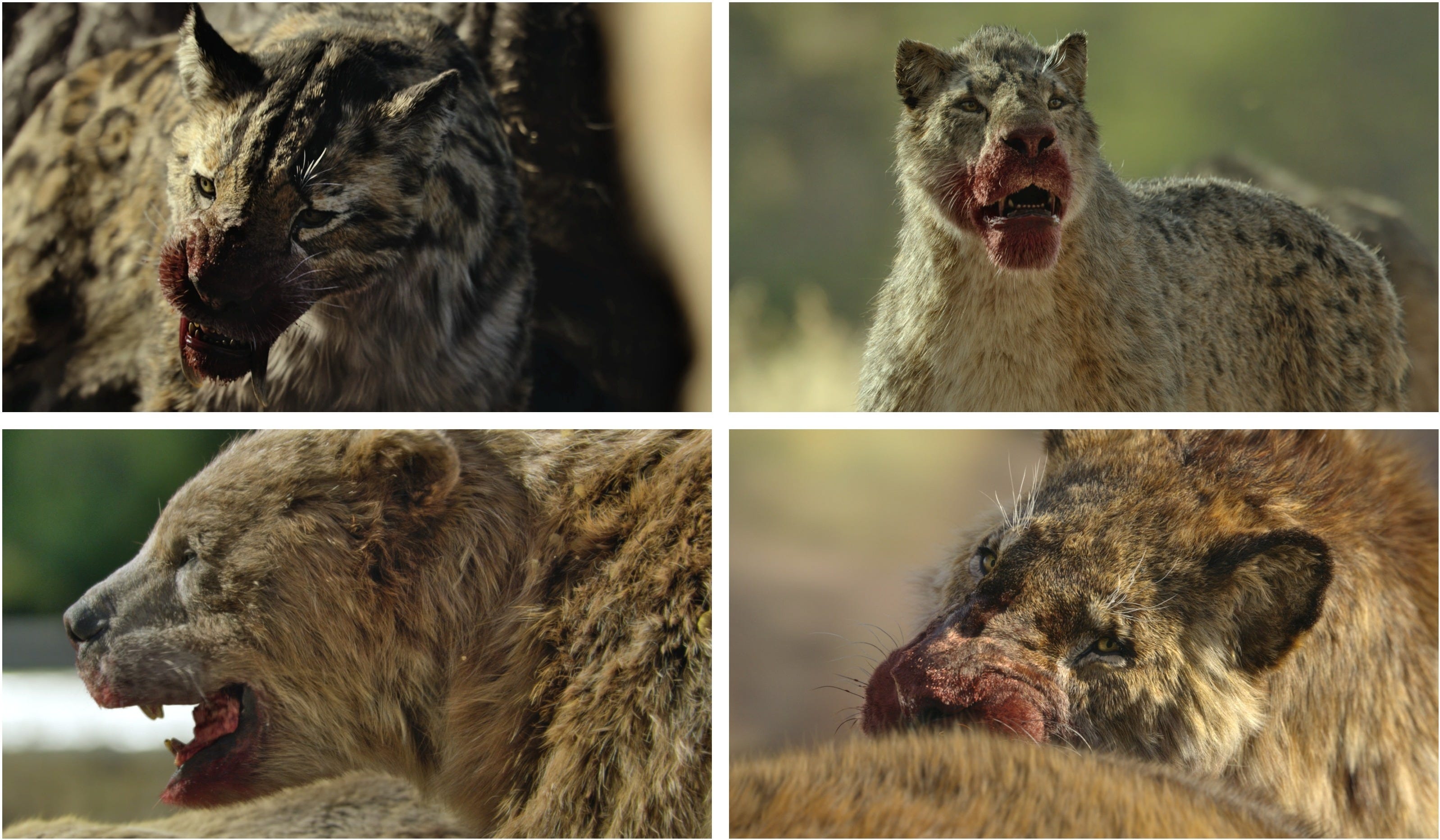
That’s weird. Anyway, the group of Homotherium traverse down a ravine in order to isolate their quarry. Hiddleston tells us about Homotherium, “She has the power of a lion, and the agility of a leopard.” While this is a bit cliché, it’s not necessarily an inaccurate description. It’s similar to how they’re described by advisor Mauricio Antón in a chapter71 he wrote for the 2022 book The Homotherium Finds from Schöningen 13 II-4: Man and Big Cats of the Ice Age. The female leaps onto the mammoth from above, and is swiftly joined by the rest of her group, whereupon it takes them about twenty-five seconds to wrestle him to the ground. This is in spite of the fact that the same female was stated to be injured in the opening scene, making her attempting such a daring ambush unlikely. It seems that the script forgot about her predicament, though, as we don’t even see her limping. In real life, they’d probably wait for him to succumb to his wounds before making an approach, but that’s not as exciting to watch. We then cut to them feeding on his carcass, and goodness me! More blood! Okay, I’ll stop going on about it. As the remainder of the mammoth herd move on, we’re told that, “A new predator born of the Ice Age is spreading to every corner of the planet.” The camera pulls back from the ravine, and we see three humans watching the mammoths from atop a cliff.
Cut to black.
Yeah, that’s how the season ends. The humans don’t do anything. Not to shamelessly self-promote, but I have written an article on the topic of hominin exclusion in the show that you’re free to read if that sounds interesting. In my opinion, this final segment would have been far more effective if we had seen a group of humans tracking and ultimately killing the injured mammoth. Both early modern humans and our Neanderthal cousins are known to have preyed on mammoths72, with a plethora of evidence to support this737475. After their absence throughout the rest of Prehistoric Planet: Ice Age, I think this would’ve been a logical and interesting way to incorporate humans into the story at the very end, as opposed to the blink-and-you’ll-miss-it cameo we got. And, injured or not, it’s also a hair more believable than five Homotherium killing a bull mammoth in under half a minute. The brevity of the human cameo leaves the audience wanting more, but I’m not sure this was the intention. Compared to the prior seasons, Prehistoric Planet: Ice Age follows a broadly linear narrative, with The Big Freeze and The Big Melt denoting the beginning and end of the Pleistocene, respectively. That doesn’t mean that a second season is not in the cards, but the impression I get is that this season is intended to be a self-contained, standalone narrative chronicling the story of the Pleistocene. While the final scene works as a sequel hook, I don’t think it works very well as a resolution to Prehistoric Planet: Ice Age’s overarching narrative through line. If it transpires that a follow-up season is not in the works, then this finale is so open-ended that it provides the audience with no resolution at all.
Final Thoughts + What’s Next?
So, the big question at the end of everything is this: does Prehistoric Planet: Ice Age measure up to the quality of its predecessors? It’s a simple question, but the answer is complicated. Where the visual effects and cinematography are concerned, a case could be made that it outshines the Maastrichtian seasons. Barring some outdated ideas, such as misconceptions around Megaloceros’ extinction, the show also does an excellent job of being up-to-date when it comes to science. However, this is where I bring up Newton’s third law of motion - for every action, there is an equal and opposite reaction. For everything this season excels at, there is something else that the Maastrichtian seasons did a slightly better job with. The most glaring example is the scarcity of scientific names in the script; obfuscating the identities of the animals on-screen diminishes this season’s educational value, which is an issue that prior seasons did not have. On the other hand, this season has some issues that have been present all throughout the show. Each episode has a central theme, such as aridification in Desert Lands, but most have at least one scene or sequence that feels tangential to the theme at best. This is nothing new; season one’s Fresh Water, for example, spends an almost inordinate amount of time focusing on terrestrial animals that hardly even interact with any water. As much as I love the first two seasons, they’re not flawless, and that’s important to keep in mind. Despite my lengthy kvetching, when all is said and done, I don’t think this season is substantially weaker than what came before. Most of the recurrent issues I’ve discussed in this review would be easy to address and remedy. If I had to put a number on it, I’d give it a 7.5/10, compared to an 8/10 for the Maastrichtian seasons.
As I’ve mentioned, Prehistoric Planet: Ice Age’s more linear narrative does not necessarily preclude the possibility of a second season. Assuming that a follow-up is under consideration, there’s an opportunity to explore more biomes and introduce the audience to more diverse and unique animals. The island ecosystems are among its most fascinating, and while we briefly visited Sumba in New Lands, a whole episode dedicated to these types of ecosystems in the same vein as season two’s Islands would be very much appreciated. Sicily, Malta, Cuba, and the Mascarene Islands are the first that come to mind. If we stick with the overarching theme of extinction, showing the endemic Mascarene avifauna - especially the famous dodo - thriving during the late Pleistocene and early Holocene would make for a bittersweet segment. Given that the first season touches on tar pits with Rancho La Brea, we could also explore this kind of environment further, showcasing tar pits from Peru, Azerbaijan, and Trinidad and Tobago, among others. While much of the marine fauna of the Pleistocene is quite similar to what we see today, I do think a marine-focused episode could work as well, if done right. It goes without saying that I’d also like to see a greater diversity of non-avian reptiles; perhaps a second second could visit the Pinjor Formation in India, home to the large gavialid Rhamphosuchus and the giant tortoise Megalochelys, among others. As great as the first season is at incorporating a wide array of habitats and animals, there is always room for improvement, and the Pleistocene offers potential for so much more.
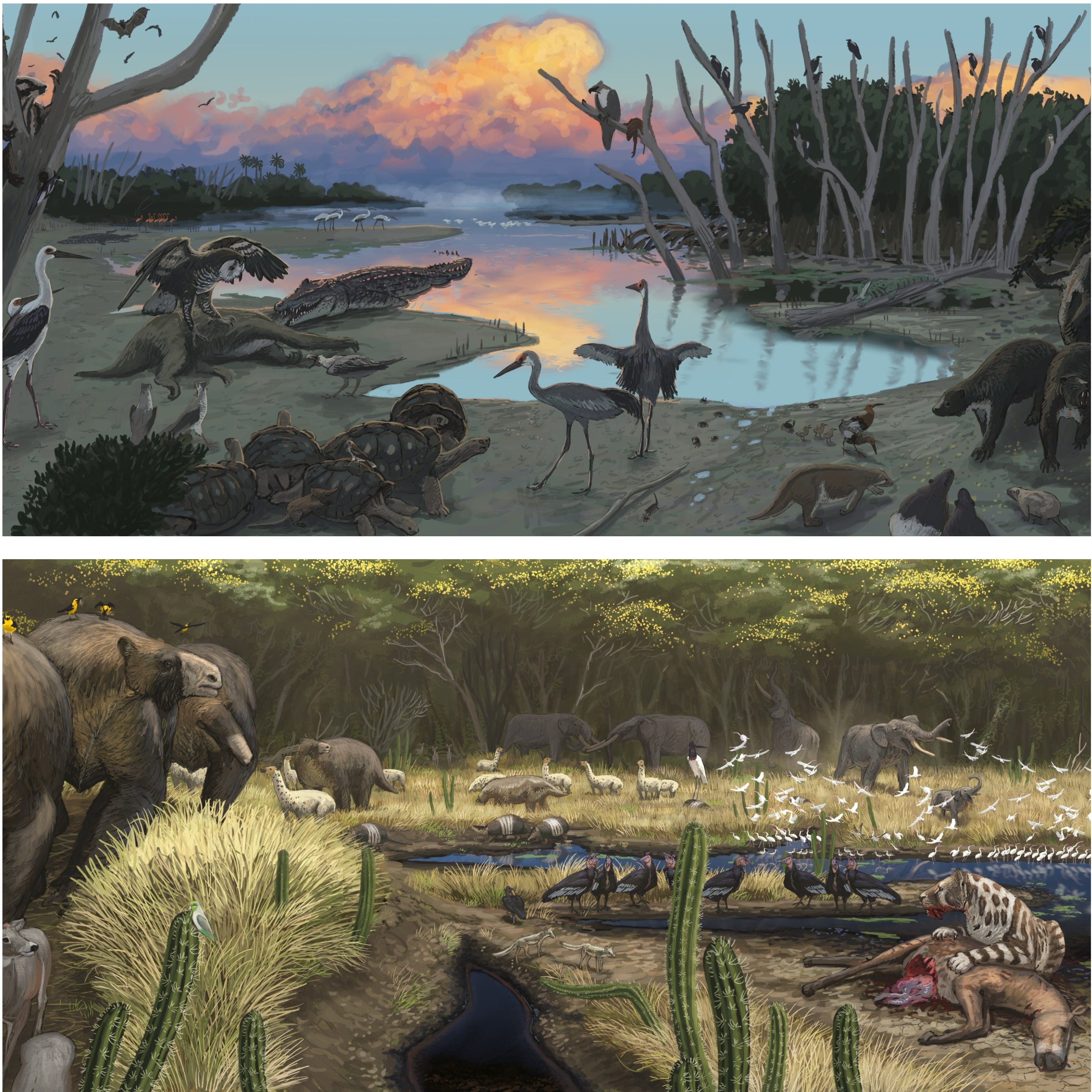
If you’ve read my other article, you already know this, but I believe a second season of Prehistoric Planet: Ice Age would be wise to include more hominins - not necessarily as central parts of the narrative, nor exclusively as antagonists, but as components of their ecosystems. This approach would be a good way to avoid being too anthropocentric, and some recent discoveries, such as hominins possibly harnessing fire up to 400,000 years ago76, would be interesting to showcase and weave into a narrative. It could also dispel misconceptions that early humans were primitive or unintelligent, a trope that is otherwise prevalent in popular media. Incorporating hominins into palaeo-media presents an undeniable challenge, and the topics surrounding them must be handled with sensitivity, but I’m confident that the creative team behind Prehistoric Planet could pull it off.
Collareta, A. et al. (2018) New insights on ancient cetacean movement patterns from oxygen-isotope analyses of a Mediterranean Pleistocene whale barnacle
Post, K. and Kompanje, E. J. O. (2010) A new dolphin (Cetacea, Delphinidae) from the Plio-Pleistocene of the North Sea
Godfrey, S. J. et al. (2025) New light on the trophic ecology of Carcharodon hastalis from teeth embedded in Miocene cetacean vertebrae from Calvert Cliffs in Maryland, USA
Ebersole, J. A., Ebersole, S. M., and Cicimurri, D. J. (2017) The occurrence of early Pleistocene marine fish remains from the Gulf Coast of Mobile County, Alabama, USA
Diedrich, C. J. (2011) The largest European lion Panthera leo spelaea (Goldfuss 1810) population from the Zoolithen Cave, Germany: specialised cave bear predators of Europe
Spassov, N. and Stoytchev, T. (2003) The presence of cave hyaena (Crocuta crocuta spelaea) in the Upper Palaeolithic rock art of Europe
Semken Jr. H. A. et al. (2022) Paleobiology of Jefferson’s Ground Sloth (Megalonyx jeffersonii) derived from three contemporaneous, ontogenetically distinct individuals recovered from Southwestern Iowa, U.S.A.
Grass, A. D. (2019) Inferring differential behavior between giant ground sloth adults and juveniles through scapula morphology
Lopatin, A. V. et al (2024) Mummy of a juvenile sabre-toothed cat Homotherium latidens from the Upper Pleistocene of Siberia
Antón, M. et al. (2022) Concealed weapons: A revised reconstruction of the facial anatomy and life appearance of the sabre-toothed cat Homotherium latidens (Felidae, Machairodontinae)
Boeskorov, G. G. et al. (2024) Reshaping a woolly rhinoceros: Discovery of a fat hump on its back
Stuart, A. J. and Lister, A. M. (2012) Extinction chronology of the woolly rhinoceros Coelodonta antiquitatis in the context of late Quaternary megafaunal extinctions in northern Eurasia
Barnett, R. et al. (2020) Genomic Adaptations and Evolutionary History of the Extinct Scimitar-Toothed Cat, Homotherium latidens
Tseng, Z. J. (2024) Bending performance changes during prolonged canine eruption in saber‐toothed carnivores: A case study of Smilodon fatalis
Antón, M. et al. (2024) Exposed weapons: A revised reconstruction of the facial anatomy and life appearance of the saber-toothed cat Megantereon (Felidae, Machairodontinae)
Christiansen, P. and Harris, J. M. (2012) Variation in Craniomandibular Morphology and Sexual Dimorphism in Pantherines and the Sabercat Smilodon fatalis
Bocherens, H. et al. (2016) Paleobiology of sabretooth cat Smilodon populator in the Pampean Region (Buenos Aires Province, Argentina) around the Last Glacial Maximum: Insights from carbon and nitrogen stable isotopes in bone collagen
Soibelzon, L. et al. (2008) A Blancan (Pliocene) short-faced bear from El Salvador and its implications for Tremarctines in South America
Deak, M. et al. (2025) Metabolic skinflint or spendthrift? Insights into ground sloth integument and thermophysiology revealed by biophysical modeling and clumped isotope paleothermometry
Dantas, M. A. T. and Oliveira, T. (2025) Were the late Pleistocene giant sloths from Brazilian intertropical region adapted to an aquatic lifestyle? A bone compactness analysis
Larmon, J. T. et al. (2019) A year in the life of a giant ground sloth during the Last Glacial Maximum in Belize
Gillette, D. D. et al. (2015) Ontogeny and Sexual Dimorphism of Glyptotherium texanum (Xenarthra, Cingulata) from the Pliocene and Pleistocene (Blancan and Irvingtonian NALMA) of Arizona, New Mexico, and Mexico
Wiest, L. A., Esker, D., and Driese, S. G. (2016) The Waco Mammoth National Monument may Represent a Diminished Watering-Hole Scenario Based on Preliminary Evidence of Post-Mortem Scavenging
Lessa, C. M. B. et al. (2021) Isotopic paleoecology (δ13C, δ18O) of two megamammals assemblages from the late Pleistocene of Brazilian intertropical region
Van der Geer, A. A. E. et al. (2016) The effect of area and isolation on insular dwarf proboscideans
Powley, M. J. et al. (2021) The Stegodon Bonebed of the Middle Pleistocene Archaeological Site Mata Menge (Flores, Indonesia): Taphonomic Agents in Site Formation
Melchor, R. M. et al. (2023) First terror bird footprints reveal functionally didactyl posture
Gerhart, L. M. and Ward, J. K. (2010) Plant responses to low [CO2] of the past
Scheff, J. et al. (2017) Are Glacials Dry? Consequences for Paleoclimatology and for Greenhouse Warming
Williams, P. W. et al. (2015) A review of New Zealand palaeoclimate from the Last Interglacial to the global Last Glacial Maximum
Pujos, F. et al. (2012) Recent Advances on Variability, Morpho-Functional Adaptations, Dental Terminology, and Evolution of Sloths
Sharp, A. C. (2016) A quantitative comparative analysis of the size of the frontoparietal sinuses and brain in vombatiform marsupials
Price, G. J. et al. (2017) Seasonal migration of marsupial megafauna in Pleistocene Sahul (Australia–New Guinea)
Price, G. J. (2008) Taxonomy and palaeobiology of the largest-ever marsupial, Diprotodon (Diprotodontidae, Marsupialia)
Buckley, M. et al. (2025) Collagen fingerprinting and sequence analysis provides a molecular phylogeny of extinct Australian megafauna
Akerman, K. and Willing, T. (2009) An ancient rock painting of a marsupial lion, Thylacoleo carnifex, from the Kimberley, Western Australia
Janes, C. M., Buttrill, K., and Figueirido, B. (2014) Locomotion in Extinct Giant Kangaroos: Were Sthenurines Hop-Less Monsters?
Wells, R. T. and Camens, A. B. (2018) New skeletal material sheds light on the palaeobiology of the Pleistocene marsupial carnivore, Thylacoleo carnifex
Prideaux, G. J. et al. (2007) An arid-adapted middle Pleistocene vertebrate fauna from south-central Australia
Bunce, M. et al. (2003) Extreme reversed sexual size dimorphism in the extinct New Zealand moa Dinornis
Huynen, L. et al. (2010) Ancient DNA reveals extreme egg morphology and nesting behavior in New Zealand’s extinct moa
Ride, W. D. L. et al. (1997) Towards a biology of Propleopus oscillans (Marsupialia: Propleopinae, Hypsiprymnodontidae)
Arman, S. D. and Prideaux, G. J. (2016) Behaviour of the Pleistocene marsupial lion deduced from claw marks in a southwestern Australian cave
Titov, V. V., Baigusheva, V. S., and Uchytel’, R. S. (2021) The experience in reconstructing of the head of Elasmotherium (Rhinocerotidae)
Geraads, D. et al. (2015) Pliocene Carnivora (Mammalia) from the Hadar Formation at Dikika, Lower Awash Valley, Ethiopia
Grohé, C., Uno, K., and Boisserie, J-R. (2022) Lutrinae Bonaparte, 1838 (Carnivora, Mustelidae) from the Plio-Pleistocene of the Lower Omo Valley, southwestern Ethiopia: systematics and new insights into the paleoecology and paleobiogeography of the Turkana otters
Gayford, J. H. et al. (2019) Cautionary tales on the use of proxies to estimate body size and form of extinct animals
Zhang, Y. et al. (2024) The demise of the giant ape Gigantopithecus blacki
Christen, Z. M., Sánchez-Villagra, M. R., and Le Verger, K. (2023) Cranial and endocranial comparative anatomy of the Pleistocene glyptodonts from the Santiago Roth Collection
Vizcaíno, S. F. et al. (2011) Proportions and function of the limbs of glyptodonts
Boeskorov, G. G. et al. (2016) Adaptation of the woolly mammoth Mammuthus primigenius (Blumenbach, 1799) to habitat conditions in the glacial period
Paterson, A. Rust, R., and Helm, C. W. (2025) The case for seismic communication among mammoths in Palaeolithic art
Nascimento, J. C. S. and Pires, M. M. (2025) Variation in prey availability over time shaped the extinction dynamics of sabre-toothed cats
Ewald, T., et al. (2018) Scimitar cat (Homotherium serum Cope) from southwestern Alberta, Canada
Power, R. J. and Compion, R. X. S. (2007) Lion predation on elephants in the Savuti, Chobe National Park, Botswana
Joubert, D. (2006) Hunting behaviour of lions (Panthera leo) on elephants (Loxodonta africana) in the Chobe National Park, Botswana.
Marsh, H., O’Shea, T. J., and Reynolds III, J. E. (2011) Steller’s sea cow: discovery, biology and exploitation of a relict giant sirenian
Donohue, S. L. et al. (2013) Was the Giant Short-Faced Bear a Hyper-Scavenger? A New Approach to the Dietary Study of Ursids Using Dental Microwear Textures
Desantis, L. R. G. et al (2019) Causes and Consequences of Pleistocene Megafaunal Extinctions as Revealed from Rancho La Brea Mammals
Reynolds, A. R., Seymour, K. L., and Evans, D. C. (2021) Smilodon fatalis siblings reveal life history in a saber-toothed cat
Carbone, C. et al. (2008) Parallels between playbacks and Pleistocene tar seeps suggest sociality in an extinct sabretooth cat, Smilodon
Martin, M. (2014) Être ou ne pas être aurignaciens ?… Telle est la question pour les Mégacéros de la grotte Chauvet
Lister, A. M. and Stuart, A. J. (2019) The extinction of the giant deer Megaloceros giganteus (Blumenbach): New radiocarbon evidence
Diedrich, C. G. (2011) A clan of Late Pleistocene hyenas, Crocuta crocuta spelaea (Goldfuss 1823), from the Rösenbeck Cave (Germany) and a contribution to cranial shape variability
Holekamp, K. E., Sakai, S. T., and Lundrigan, B. L. (2007) Social intelligence in the spotted hyena (Crocuta crocuta)
Torres, C. R. and Clarke, J. A. (2018) Nocturnal giants: evolution of the sensory ecology in elephant birds and other palaeognaths inferred from digital brain reconstructions
Hansford, J. P. et al. (2021) Simultaneous extinction of Madagascar’s megaherbivores correlates with late Holocene human-caused landscape transformation
Worman, C. O’D. and Kimbrell, T. (2008) Getting to the hart of the matter: did antlers truly cause the extinction of the Irish elk?
Ochando, J. et al. (2020) Palynology and chronology of hyaena coprolites from the Piñar karstic Caves Las Ventanas and Carihuela, southern Spain
Hu, J. et al (2021) Ancient mitochondrial genomes from Chinese cave hyenas provide insights into the evolutionary history of the genus Crocuta
Antón, M. (2022) “Behaviour of Homotherium in the Light of Modern Big Cats”, in Conard, N. J., Hassmann, H., Hillgruber, K. F., Serangeli, J., and Terberger, H. (eds.). The Homotherium Finds from Schöningen 13II-4: Man and Big Cats of the Ice Age. Heidelberg: Propylaeum. pp. 19–34.
Metcalfe, J. Z. (2017) Proboscidean isotopic compositions provide insight into ancient humans and their environments
Wotjal, P. et al. (2019) The earliest direct evidence of mammoth hunting in Central Europe – The Kraków Spadzista site (Poland)
Mussi, M. and Villa, P. (2008) Single carcass of Mammuthus primigenius with lithic artifacts in the Upper Pleistocene of northern Italy
Nikolskiy, P. and Pitulko, V. (2013) Evidence from the Yana Palaeolithic site, Arctic Siberia, yields clues to the riddle of mammoth hunting
Davis, R. et al. (2025) Earliest evidence of making fire
Finally had time to read all of this--really good!